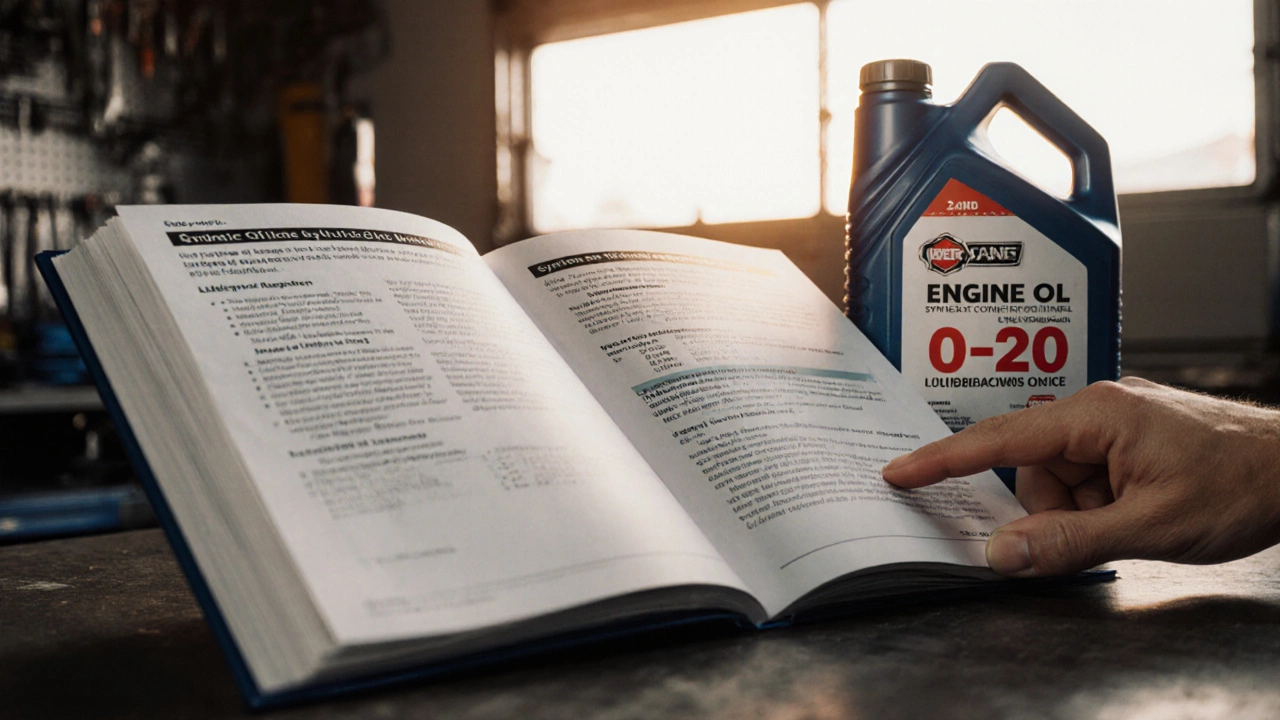
Choosing the right engine oil isn’t about guessing or following what your neighbor uses. It’s about matching your car’s needs with the oil that keeps it running smoothly for years. Put the wrong oil in, and you could be looking at reduced fuel efficiency, increased wear, or even engine damage. Get it right, and your engine will thank you with smoother starts, better performance, and longer life.
Start with your owner’s manual
Your car’s owner’s manual is the single most reliable source for engine oil recommendations. Manufacturers don’t guess-they test. They run engines for thousands of hours under different conditions to find the exact oil that works best. Look for the section labeled "Lubrication," "Engine Oil," or "Maintenance." You’ll find two key details: the viscosity grade (like 5W-30) and the performance specification (like API SP or ILSAC GF-6).
Don’t ignore this. A 2023 Toyota Camry requires 0W-20 synthetic oil with API SP certification. A 2022 Ford F-150 with a 3.5L EcoBoost engine needs 5W-30 synthetic with Ford WSS-M2C947-A. Swap them, and you’re not just wasting money-you’re risking performance.
Understand viscosity: what do the numbers mean?
Engine oil viscosity is measured in two parts: the number before the W (winter) and the number after. For example, 10W-40 means:
- 10W = how well it flows in cold temperatures (lower = thinner when cold)
- 40 = how thick it stays at engine operating temperature (higher = thicker when hot)
Modern engines use thinner oils like 0W-20 or 5W-30 because they reduce friction, improve fuel economy, and help engines warm up faster. Older engines, especially those with higher mileage, sometimes need thicker oils like 10W-40 to seal worn components better.
Using oil that’s too thick can cause sluggish cold starts, especially in winter. Oil that’s too thin may not protect high-load parts like turbochargers or valve trains under heavy stress. Stick to the range your manual specifies-don’t go outside it unless you’re addressing a known issue like oil consumption.
Synthetic vs. conventional vs. blend
Not all oils are created equal. There are three main types:
- Conventional oil-refined from crude oil. Cheaper, but breaks down faster and doesn’t handle extreme heat or cold as well.
- Synthetic oil-engineered in labs with uniform molecules. Better protection, lasts longer, flows better in cold weather, and resists sludge buildup.
- Synthetic blend-a mix of conventional and synthetic. A middle ground in price and performance.
Most cars made after 2010 require synthetic oil. Even if your manual says "conventional acceptable," switching to synthetic is almost always a smart move. Synthetic oils reduce engine wear by up to 40% compared to conventional, according to tests by the American Petroleum Institute. They also let you extend oil change intervals safely-often to 10,000 or even 15,000 miles, depending on driving conditions.
High-mileage vehicles (over 75,000 miles) might benefit from oils labeled "High Mileage." These contain seal conditioners to reduce leaks and additives to combat wear in aging engines. They’re not magic, but they’re designed for the realities of older engines.
Check the API and ILSAC ratings
Look for the API donut symbol on the oil bottle. It tells you two things:
- The service category (e.g., SP, SN, SM)-this shows performance level. SP is the current standard for gasoline engines as of 2025.
- The energy-conserving rating (if present)-means the oil helps improve fuel economy.
ILSAC GF-6 is the latest international standard, introduced in 2020. It’s required for most new vehicles. If your car is from 2021 or newer, you need GF-6 or GF-6A. Older cars can use GF-5 or earlier, but GF-6 is backward compatible and offers better protection.
Don’t buy oil without these labels. Generic or unmarked oils might meet basic standards, but they lack the additives and testing needed for modern engines with direct injection, turbochargers, and variable valve timing.

What about diesel engines?
If you drive a diesel truck or SUV, you need different oil. Look for API CK-4 or FA-4 ratings, designed specifically for diesel engines. These oils handle soot, higher temperatures, and EGR systems better than gasoline engine oils. Using gasoline oil in a diesel engine can cause premature failure of the diesel particulate filter (DPF) or turbocharger.
Heavy-duty diesel engines (like in commercial trucks) often require oils with higher viscosity (15W-40) and specific additives for extended drain intervals. Always check your diesel-specific manual.
Climate matters too
Where you live affects oil choice. If you’re in Minnesota, where winter hits -20°F, you need a 0W-20 or 0W-30 oil to ensure it flows fast enough at startup. In Arizona, where summer temps hit 115°F, you might lean toward 5W-30 or even 10W-30 if your engine tolerates it. But don’t change viscosity just because of weather-stick to your manual’s recommendation unless you have a reason to deviate.
Some drivers in extreme climates use multi-grade oils with wider viscosity ranges (like 5W-50), but these are rare in modern passenger cars. They’re typically for racing or heavy-duty use.
Common mistakes to avoid
- Using 10W-40 in a car that needs 0W-20-this can trigger check engine lights and reduce fuel economy by up to 2%.
- Buying "premium" oil that doesn’t match the specification-brand doesn’t matter as much as the standard.
- Mixing synthetic and conventional oil-while not immediately harmful, it defeats the purpose of synthetic’s superior performance.
- Assuming "all synthetic" means it’s good for your car-check the viscosity and API rating first.
There’s no benefit to using 5W-50 in a compact car just because it sounds "tougher." That’s not performance-it’s unnecessary risk.
What if your manual is lost?
If you don’t have the manual, visit the manufacturer’s website and search for your exact year, make, model, and engine size. Most have online maintenance guides. Alternatively, use a trusted third-party tool like the Mobil 1 Oil Selector or Valvoline’s Oil Finder. These tools ask for your vehicle details and return the exact oil type recommended by the manufacturer.
Never rely on auto parts store employees for oil advice unless they’re pulling the info directly from a manufacturer database. Many still push the same 10W-40 they’ve sold for decades-even on new cars.
When to change your oil
Modern synthetic oils last longer, but that doesn’t mean you can ignore oil life monitors. Most cars now have sensors that track driving habits, temperature, and engine load to tell you when it’s time for a change. If your car has an oil life indicator, follow it. If not, stick to the manufacturer’s interval-usually 7,500 to 10,000 miles for synthetic, or 3,000 to 5,000 for conventional.
Severe driving conditions (short trips under 10 miles, towing, dusty roads, stop-and-go traffic) can shorten oil life. In those cases, change oil every 5,000 miles regardless of what the monitor says.
Final checklist before buying
Before you hand over your credit card, verify these five things:
- Viscosity matches your manual (e.g., 5W-30, not 10W-40)
- API rating is SP or higher (for gasoline engines)
- ILSAC GF-6 or GF-6A if your car is 2021 or newer
- Type is synthetic (unless your manual specifically says otherwise)
- It’s from a reputable brand (Mobil 1, Castrol EDGE, Shell Rotella, Pennzoil, etc.)
That’s it. No guesswork. No myths. Just the facts your car was built for.
Can I use synthetic oil in an older car?
Yes, synthetic oil is safe for older cars-even those with over 100,000 miles. Modern synthetics are formulated to be compatible with older seals and materials. In fact, many high-mileage vehicles run better on synthetic because it reduces friction and prevents sludge buildup. If your car has oil leaks, consider a high-mileage synthetic with seal conditioners, but switching from conventional to synthetic won’t cause leaks on its own.
Is full synthetic worth the extra cost?
Absolutely. Synthetic oil costs more per quart, but it lasts longer and protects better. For most drivers, switching to synthetic saves money over time by extending oil change intervals and reducing engine wear. A typical oil change with synthetic might cost $15 more, but if it lasts 10,000 miles instead of 5,000, you’re saving two changes a year. Plus, better protection means fewer costly repairs down the road.
Can I mix different brands of engine oil?
Yes, you can mix different brands as long as they meet the same viscosity and performance standards (like API SP and ILSAC GF-6). Oil brands use different additive packages, but they’re all designed to meet the same industry specs. Mixing them won’t harm your engine. However, it’s best to stick with one brand for consistency, especially if you’re using a high-mileage or specialty oil.
What happens if I use the wrong oil viscosity?
Using oil that’s too thick can cause poor cold-start performance, increased fuel consumption, and higher engine strain. Oil that’s too thin may not provide enough protection under load, leading to metal-on-metal contact and accelerated wear. In turbocharged engines, thin oil can lead to bearing failure. Always follow the viscosity grade in your owner’s manual-it’s not a suggestion, it’s a requirement for engine longevity.
Do I need to flush my engine before switching to synthetic oil?
No. Engine flushes are unnecessary and often harmful. Modern synthetic oils are designed to clean deposits as they circulate. Flushing can dislodge sludge that’s settled in harmless areas, causing blockages in oil passages. Unless your engine has a known sludge problem (rare in well-maintained cars), just drain the old oil and replace it with synthetic. Your engine will clean itself naturally over the next few oil changes.
If you’re unsure, ask your mechanic to show you the exact specification from your owner’s manual before they fill your engine. Better yet, do it yourself. Your engine doesn’t care about brand loyalty-it cares about the right numbers on the bottle.