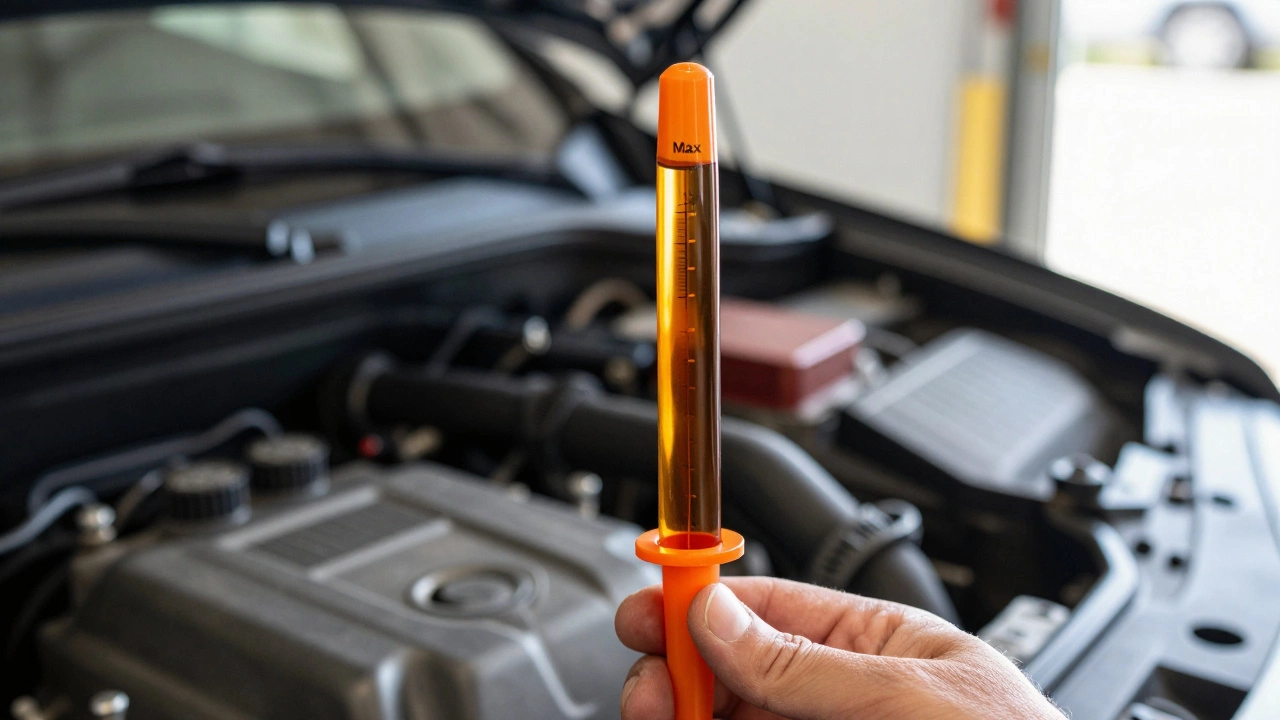
Engine Oil Level Simulator
Adjust Oil Level
Drag the slider to simulate different oil levels in your engine.
Visual Simulation
The visualization shows oil level relative to crankshaft position
Recommendation
Keep your oil level between the MIN and MAX marks on the dipstick for optimal engine performance and longevity.
There is a specific kind of panic that hits when you pull the dipstick out after an oil change and see the black line sticking up past the 'Full' mark. You just wanted to keep your engine running smoothly, but now you’re wondering if you’ve caused irreversible damage. The short answer? It’s rarely catastrophic immediately, but it is definitely not something you should ignore.
Adding too much engine oil is a lubricant essential for reducing friction between moving parts within a vehicle's engine creates a problem known as hydrolock or excessive crankcase pressure. When the oil level sits above the manufacturer’s recommended maximum, the spinning crankshaft acts like a giant mixer, whipping the oil into a frothy mess. This aerated oil cannot lubricate effectively, leading to increased wear, smoke, and potentially expensive repairs.
The Immediate Physical Signs of Overfilled Oil
You don’t need a mechanic to tell you if you’ve gone overboard; your car will usually give you clues right away. The most obvious indicator is visual. If you check the dipstick and the oil is well above the upper hash mark or the cross-hatched zone, you have a surplus. But what happens when you actually drive the car?
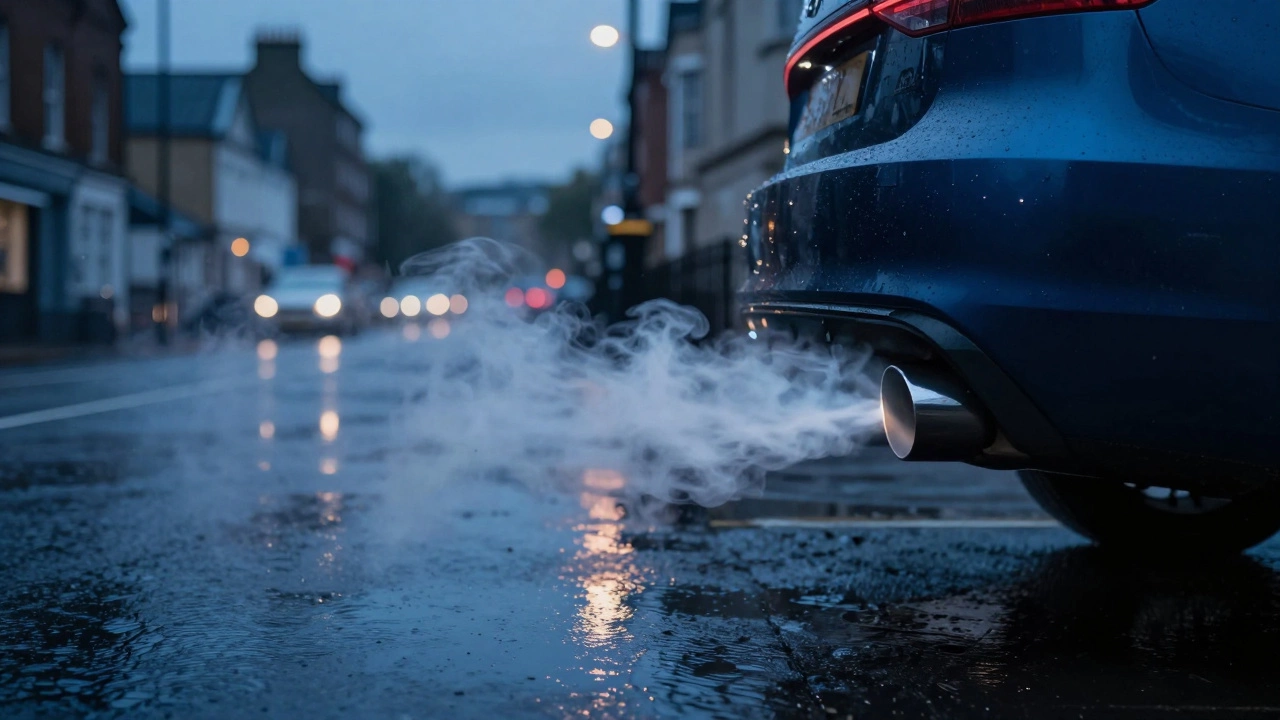
- Blue or Grey Exhaust Smoke: This is the classic symptom. When the crankshaft dips into the excess oil, it splashes it onto the cylinder walls. The pistons then push this oil up into the combustion chamber, where it burns along with the fuel. You’ll see a puff of blueish-grey smoke from the tailpipe, especially during acceleration or hard braking.
- Burning Oil Smell: Along with the smoke comes the scent. It smells distinctively acrid, like burnt toast or chemicals. If you notice this smell while driving or immediately after parking, suspect an oil issue first.
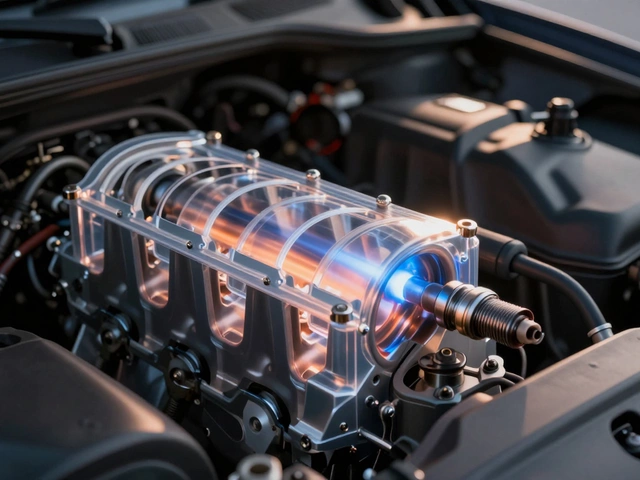
- Fouled Spark Plugs: If you leave the car running for a while with too much oil, the spark plugs can get coated in carbon and oil residue. This leads to misfires, rough idling, and a lack of power. In severe cases, the engine might struggle to start at all.
- Oil Leaks from Seals: Excess oil increases internal pressure in the engine block. This pressure seeks the path of least resistance, which often means pushing past the oil seals (like the rear main seal) or gaskets. You might find fresh puddles of oil under the car shortly after driving.
Why Does Extra Oil Cause Problems?
It seems counterintuitive. More lubrication should mean less wear, right? Unfortunately, engines are designed with precise tolerances. The crankshaft is the rotating component that converts the linear motion of pistons into rotational motion spins at thousands of revolutions per minute (RPM). At high speeds, the bottom of the crankshaft throws the oil around violently.
When the oil level is correct, the crankshaft stays clear of the bulk fluid. When it’s too high, the crankshaft churns the oil, introducing air bubbles. Think of it like shaking a bottle of salad dressing. That foamy mixture doesn’t flow like liquid oil. It compresses easily, meaning the oil pump struggles to maintain hydraulic pressure. Without proper pressure, metal parts grind against metal parts, causing rapid wear on bearings and camshafts.
Furthermore, modern engines have complex ventilation systems, specifically the Positive Crankcase Ventilation (PCV) system. This system recirculates gases from the crankcase back into the intake manifold to be burned. If there is too much oil, these vapors carry oil mist with them. This floods the intake valves and turbochargers (if equipped) with oil, leading to clogged sensors and reduced performance.
How to Check Your Oil Level Correctly
Before you panic, make sure you aren’t misreading the dipstick. Many drivers make mistakes here, leading to false alarms or actual overfills.
- Park on Level Ground: An inclined surface skews the reading. Find a flat driveway or parking spot.
- Wait for the Engine to Cool: If you just drove the car, wait 5-10 minutes. Oil needs time to drain back down from the upper galleries into the sump. Checking hot, circulating oil gives a low reading, tempting you to add more.
- Wipe the Dipstick Clean: Pull it out, wipe it with a clean rag or paper towel, and reinsert it fully.
- Read Both Marks: Most dipsticks have two marks or a textured area. The lower mark is 'Min' and the upper is 'Max'. You want the oil level to be in the middle or slightly towards the top, but never above the Max line.
If your car has an electronic oil monitor instead of a physical dipstick, ensure the car is stationary and the engine is running (or off, depending on the manufacturer’s instructions-check your manual). Electronic sensors can sometimes drift, so if the digital readout says 'High,' verify with a physical dipstick if possible.
What to Do If You Have Too Much Oil
Don’t drive the car long distances until this is fixed. Here is how to fix it, ranked by ease and safety.
Option 1: Drain From the Bottom (The Professional Way)
If you have a jack and a drain pan, you can simply loosen the oil drain plug slightly. Let a small amount of oil trickle out-maybe half a cup or a quart-then tighten it back up. Recheck the level. This is the cleanest method but requires getting under the car, which carries safety risks if you’re not experienced.
Option 2: Use a Fluid Extractor Pump (The Easiest DIY Way)
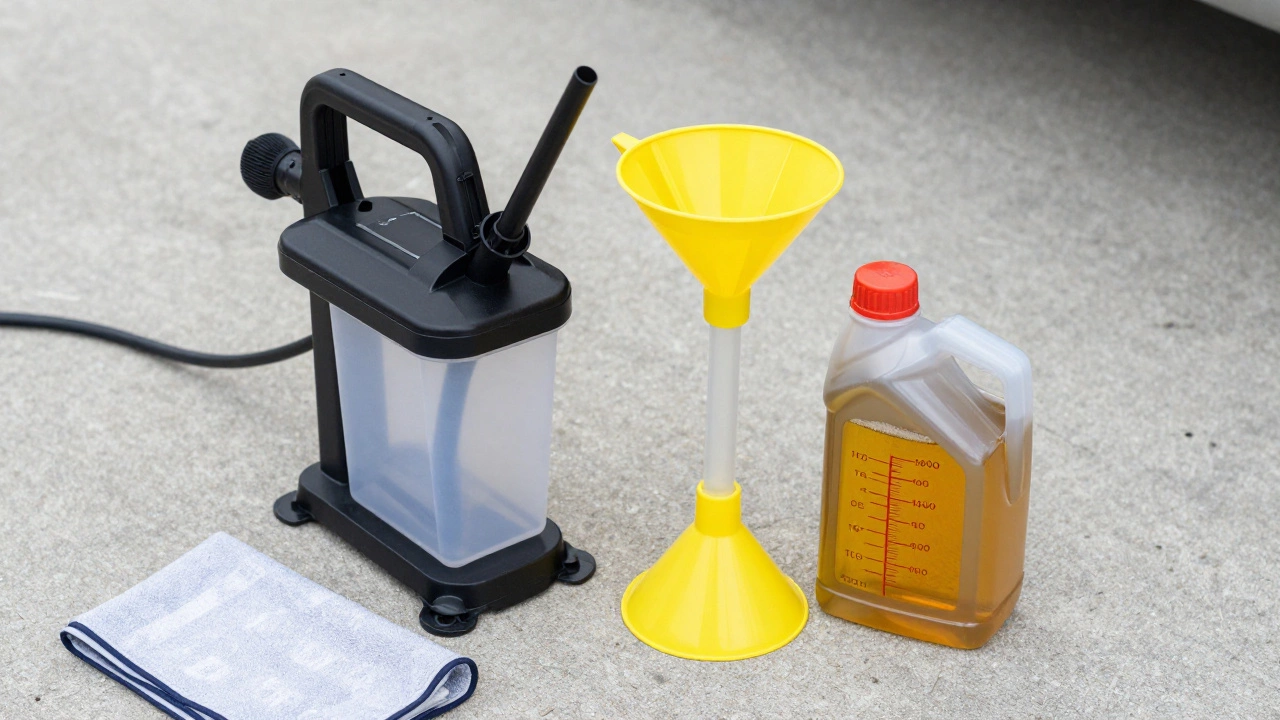
You can buy a hand-held or battery-powered oil extractor online or at auto parts stores for around £20-£40. These devices use a tube that you insert through the dipstick tube. You pump the handle to create suction, pulling the excess oil out into a container. It’s messy-free and very effective. Just remember to dispose of the old oil properly at a recycling center.
Option 3: Visit a Mechanic
If you’re uncomfortable working under the car or buying tools, call a local garage. They can drain the excess oil in minutes. There might be a small labor fee, but it’s cheaper than replacing a damaged catalytic converter later.
| Method | Difficulty | Cost | Best For |
|---|---|---|---|
| Drain Plug | Medium | Low (Pan needed) | DIYers with jacks |
| Extractor Pump | Easy | Medium (£20-£40) | Clean, precise removal |
| Mechanic | None | High (Labor fee) | Those without tools/space |
Long-Term Risks of Ignoring the Issue
If you only added a tiny bit extra-say, 200ml-it might not cause immediate harm. But if you’re a quart (liter) over, the risks escalate quickly.
- Catalytic Converter Damage: Burning excess oil dumps unburnt hydrocarbons and phosphorus into the exhaust system. The catalytic converter is an emissions control device that converts toxic gases into less harmful pollutants can become clogged or poisoned by these contaminants. Replacing a catalytic converter costs hundreds, sometimes thousands, of pounds.
- Turbocharger Failure: If you drive a turbocharged car, excess oil can leak past the turbo seals. This leads to oil burning in the turbine housing, causing overheating and eventual turbo failure.
- Increased Fuel Consumption: A fouled engine works harder. Misfires and poor combustion mean you’re using more fuel to go the same distance.
Preventing Future Overfills
Avoiding this mistake is mostly about patience and preparation.
First, always know your engine’s capacity. Look in your owner’s manual. A typical family car might take 4.5 liters. If you bought a 5-liter bottle, you already know you have leftover oil. Don’t pour it all in "just in case." Add 80% of the total, check the dipstick, and then top up slowly.
Second, use a funnel with a screen or a measuring jug. Pouring directly from a large plastic bottle makes it easy to lose track of volume. Measuring jugs allow you to add oil in controlled increments, such as 200ml at a time.
Finally, store your leftover oil properly. Label the container with the date and oil type (e.g., 5W-30 Synthetic). Keep it in a cool, dry place. Oil degrades over time, even unopened, so don’t hoard it for five years.
Is it better to have too much oil or too little?
Too little oil is generally more dangerous in the short term because it leads to immediate metal-on-metal contact and seizure. However, too much oil causes significant long-term damage to emissions systems and internal components. Both are bad, but low oil kills an engine faster, while high oil ruins it slower and more expensively.
How much oil is too much?
Anything above the 'Max' or 'Full' mark on the dipstick is technically too much. However, being slightly over (within 100-200ml) is often tolerated by modern engines. Being half a liter or more over is where serious problems like foaming and seal leaks begin to occur.
Can I drive my car if I overfilled the oil?
You can drive it a short distance to a safe location or a mechanic, but avoid highway speeds or heavy acceleration. High RPMs increase the churning effect, worsening the foaming and potential for smoke and leaks. Do not take a long road trip until the level is corrected.
Does overfilling oil void the warranty?
In the UK and EU, manufacturers must prove that your action caused the damage to void the warranty. If they can show that the engine failure was due to improper maintenance (like chronic overfilling), they may deny the claim. Always follow the manufacturer's specified oil levels to stay protected.
Why does my car burn oil even though I just changed it?
If you recently changed the oil and now see smoke, it’s likely because you overfilled it. The excess oil is being whipped into the combustion chamber. Other causes include worn piston rings or valve stem seals, but given the context of a recent oil change, overfilling is the prime suspect.