Air Filter Health Checker
Check your air filter condition
Answer a few questions to determine if your air filter is performing well or needs replacement.
Your Air Filter Status
Most drivers don’t think about their air filter until the engine starts acting up. But a bad air filter doesn’t just hurt performance-it can cost you money, damage your engine, and even make your car harder to start on cold mornings. The good news? You don’t need a mechanic to check it. With a quick visual and a few simple tests, you can tell if your air filter is still doing its job-or if it’s time for a new one.
What an air filter actually does
Your car’s air filter doesn’t just keep dust out of the engine. It stops dirt, pollen, leaves, and even small insects from getting into the combustion chamber. Inside the engine, tiny particles can scratch cylinder walls, clog fuel injectors, and wear down valves. Over time, that leads to reduced power, higher fuel use, and expensive repairs.
Modern engines are designed to run on clean air. Even a small amount of dirt can throw off the air-fuel mixture. That’s why a clogged or damaged filter doesn’t just make your car slower-it makes it less efficient, too. In the UK, where roads can be dusty after dry spells and pollen levels spike in spring, a clean air filter isn’t a luxury. It’s basic maintenance.
Signs your air filter is bad
Here’s what to watch for if you suspect your air filter is failing:
- Reduced acceleration - When you press the gas pedal and the car feels sluggish, especially at highway speeds, it could mean the engine isn’t getting enough air.
- Lower fuel economy - If you’ve noticed your tank doesn’t last as long as it used to, and you haven’t changed your driving habits, a dirty filter might be to blame. A clogged filter forces the engine to work harder, burning more fuel.
- Engine misfires or rough idling - If the engine shakes when you’re stopped at a light or sputters when you start it, restricted airflow could be causing uneven combustion.
- Black smoke from the exhaust - This usually means the engine is running rich (too much fuel, not enough air). A blocked filter can cause this imbalance.
- Check Engine light - Modern cars have sensors that detect airflow problems. A dirty air filter can trigger a P0171 or P0174 code, meaning the system is running too lean.
These symptoms don’t always mean your filter is bad-but if you’re seeing two or more of them, it’s worth checking.
How to check your air filter yourself
You don’t need tools or training. Just follow these steps:
- Locate the air filter box - It’s usually a black plastic box near the top of the engine, connected to a large hose. Look for clips or screws holding it shut.
- Open the box - Most boxes snap open with a few clips. Some need a screwdriver. Don’t force it.
- Remove the filter - Pull it out carefully. Don’t shake it-dirt might fall into the intake.
- Hold it up to a bright light - If you can’t see light coming through the filter material, it’s clogged. A clean filter looks like white or off-white mesh. A dirty one looks gray or brown, with thick layers of grime.
- Check for damage - Look for tears, holes, or cracks in the rubber frame. A damaged seal lets unfiltered air into the engine.
Pro tip: Do this every 6,000 miles-or every 6 months if you drive mostly on country roads or in dusty areas. In cities like Manchester, where traffic and damp weather are common, you might get 12,000 miles out of a filter. But never wait longer than 15,000 miles without checking.
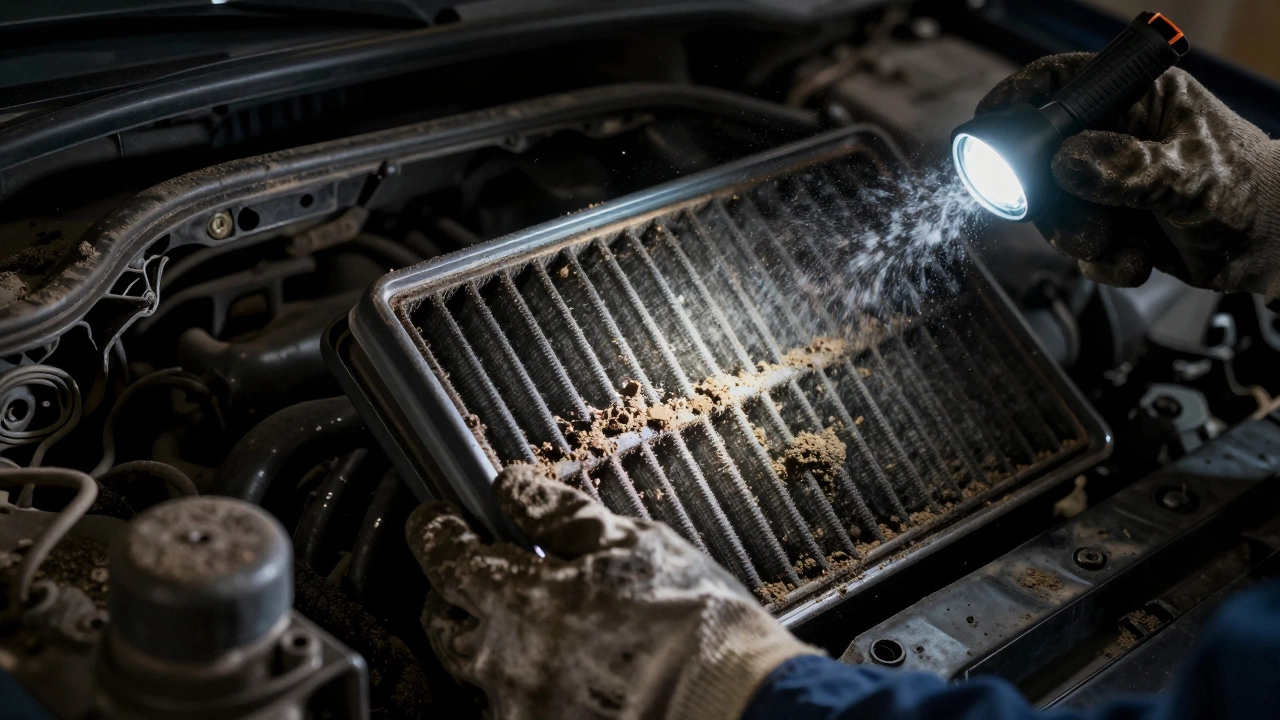
What a clean vs. dirty air filter looks like
Think of it like a coffee filter. A clean one is light, porous, and lets liquid pass easily. A dirty one is dark, stiff, and clogged with grounds.
A good air filter has:
- Uniform color (white, cream, or light gray)
- No visible debris or clumps of dirt
- Intact rubber seals around the edges
- Flexible material that bends without cracking
A bad air filter has:
- Dark brown or black coloring
- Thick, sticky dust layers
- Cracked or brittle rubber frame
- Leaves, twigs, or insects trapped inside
Some filters have a dirt-indicator line printed on the side. If the grime has reached that line, replace it. Not all filters have this, but if yours does, treat it like a warning light.
When to replace your air filter
Most manufacturers recommend replacing the air filter every 12,000 to 15,000 miles. But that’s just a guideline. Your driving conditions matter more.
Replace it sooner if you:
- Drive on gravel roads or unpaved tracks
- Live near construction sites or dusty areas
- Have pets that ride in the car (hair and dander get sucked in)
- Experience long dry spells followed by wind
- Notice any of the symptoms listed earlier
Driving in Manchester during winter? Wet leaves and road spray can clog filters faster than you think. Don’t assume a filter lasts a full year. Check it every six months.
Replacing a filter is cheap-usually under £20-and takes less than 10 minutes. Skipping it can lead to engine repairs costing hundreds or even thousands.

What happens if you ignore a bad air filter
Ignoring a dirty air filter doesn’t just hurt performance. It can cause permanent damage:
- Engine wear - Tiny particles act like sandpaper on pistons and cylinders.
- Reduced resale value - Buyers check maintenance records. A neglected air filter raises red flags.
- Failed emissions tests - In the UK, a clogged filter can cause higher CO or NOx readings, leading to an MOT failure.
- Increased repair costs - Replacing a damaged throttle body or fuel injector because of a dirty filter can cost £300-£800.
It’s not an emergency-but it’s a slow leak. Every mile driven with a bad filter chips away at your engine’s life.
What to look for when buying a new filter
Not all air filters are created equal. Stick to reputable brands like Mann-Filter, K&N, or Bosch. Avoid no-name filters sold in discount packs-they often have poor seals or thin material that lets dust through.
Check the part number on your old filter. Match it exactly. Even small differences in size or shape can cause leaks or airflow problems.
Performance filters (like K&N’s reusable ones) are popular, but they need regular cleaning and oiling. If you’re not willing to maintain them, stick with a standard paper filter. They’re cheaper, just as effective, and require zero upkeep.
Final checklist: Is your air filter good or bad?
Before you head out, ask yourself:
- Can I see light through the filter material?
- Is the filter color mostly white or cream?
- Are there cracks in the rubber frame?
- Has it been more than 12,000 miles or 6 months since I last checked?
- Is my car losing power or using more fuel than usual?
If you answered yes to any of the last three, replace it. No need to wait.
Keeping your air filter clean is one of the easiest, cheapest ways to keep your car running smoothly. It doesn’t take much time-but it makes a huge difference.
How often should I replace my car’s air filter?
Most manufacturers suggest replacing the air filter every 12,000 to 15,000 miles. But if you drive in dusty areas, on gravel roads, or in cities with high pollution, check it every 6,000 miles or every six months. In places like Manchester, where damp weather and traffic are common, don’t wait longer than 15,000 miles without inspecting it.
Can a dirty air filter cause my car to stall?
Yes. A severely clogged air filter restricts airflow so much that the engine can’t get enough oxygen to burn fuel properly. This can cause misfires, rough idling, or even stalling-especially when accelerating or climbing hills. If your car stalls frequently and the air filter looks black and dirty, replace it before assuming it’s something more serious.
Can I clean my air filter instead of replacing it?
Only if it’s a reusable performance filter, like a K&N. Standard paper filters can’t be cleaned safely. Washing or blowing them out damages the fibers and lets dirt through. Even if it looks clean after cleaning, the structure is weakened. Always replace paper filters-they’re inexpensive and designed to be disposable.
Will a new air filter improve my fuel economy?
Yes-if your old filter was clogged. A clean filter allows better airflow, helping the engine burn fuel more efficiently. In tests, replacing a severely dirty filter can improve fuel economy by 6% to 11%. For most drivers, that’s about 1-2 extra miles per gallon. Over a year, that adds up to real savings.
Can a bad air filter cause the Check Engine light to come on?
Absolutely. Modern cars have mass airflow sensors that monitor how much air enters the engine. If the filter is too dirty, the sensor detects a drop in airflow and triggers codes like P0171 (System Too Lean) or P0174. These often get misdiagnosed as fuel system problems. Always check the air filter first before spending money on sensors or injectors.