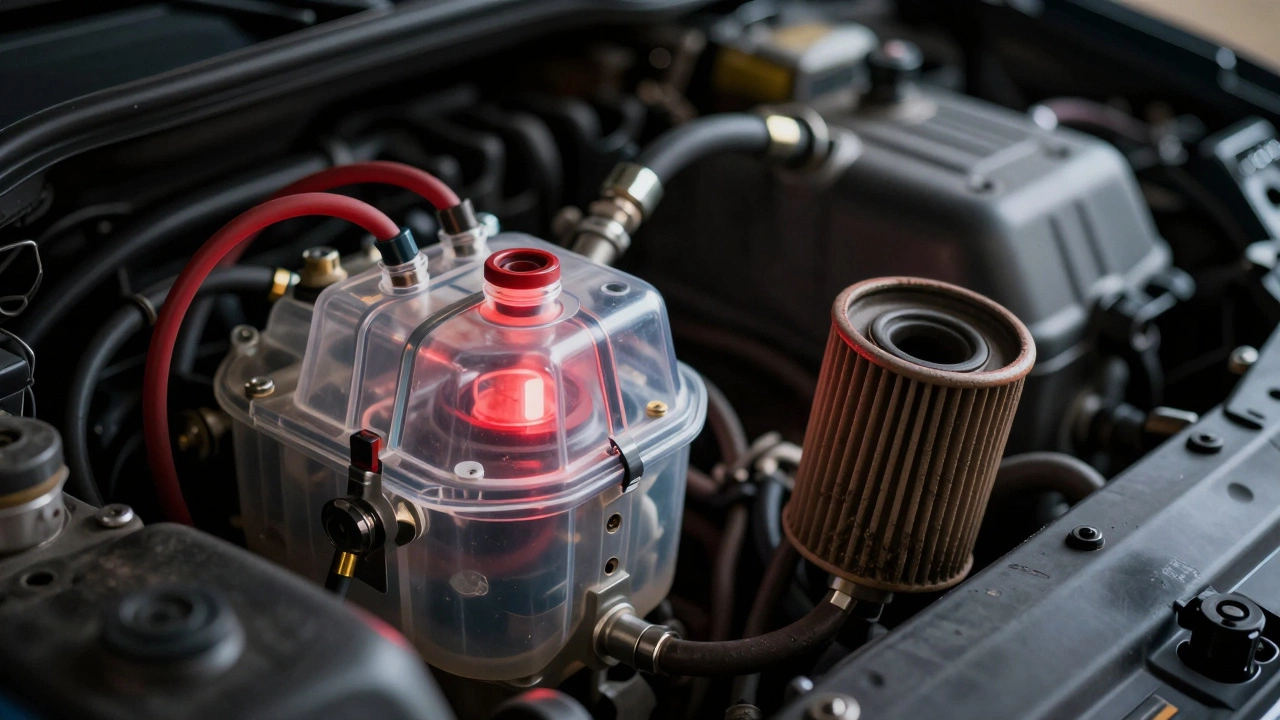
Fuel System Diagnostic Tool
Symptom Check
Select all symptoms you're experiencing to determine whether the issue is likely your fuel pump or fuel filter.
If your car sputters, stalls, or won’t start at all - especially when you’re on the highway or climbing a hill - it’s not always the battery or the spark plugs. More often than not, the problem lies in your fuel system. Two of the most common culprits? A failing fuel pump or a clogged fuel filter. Both are essential to getting gas from the tank to the engine, but they fail in different ways. Knowing how to tell them apart saves you time, money, and a lot of roadside frustration.
What a Fuel Pump Actually Does
The fuel pump is a small electric motor, usually located inside your gas tank. Its job is simple: push gasoline from the tank up to the engine under pressure. Modern cars need around 30 to 60 psi of pressure to run properly. If the pump can’t deliver that, the engine won’t get enough fuel - even if there’s gas in the tank.
Most fuel pumps last between 100,000 and 150,000 miles. But they don’t always die quietly. When they start to fail, they often get weaker before they stop completely. You’ll notice it before your car stops running entirely.
What a Fuel Filter Does
The fuel filter sits between the tank and the engine. It’s a tiny mesh screen (or paper/carbon element) that catches dirt, rust, and debris before they reach the fuel injectors. Most manufacturers recommend replacing it every 20,000 to 40,000 miles, but many drivers skip it. That’s a mistake.
A clogged filter doesn’t just restrict flow - it forces the fuel pump to work harder. Over time, that extra strain can kill the pump. So even if you think the filter is the problem, it might be killing your pump too.
Signs Your Fuel Pump Is Going Bad
- Your car struggles to start - especially after sitting for a while. If you turn the key and hear a faint whirring sound, then nothing, that’s a red flag. A healthy pump makes a brief buzzing noise for a second when you turn the ignition on.
- Engine sputters at high speeds - like when you’re on the highway and the RPMs drop unexpectedly. This happens because the pump can’t keep up with demand.
- Loss of power under load - climbing hills, accelerating hard, or towing. The engine feels like it’s running out of breath.
- Engine stalls at idle - especially in traffic. A weak pump can’t maintain steady pressure when the engine isn’t demanding much fuel.
- Complete no-start condition - if the pump dies entirely, the engine won’t turn over. No fuel = no combustion.
These symptoms usually get worse over time. If you’ve noticed any of these over the past few weeks, your pump is likely on its last legs.

Signs Your Fuel Filter Is Clogged
- Engine misfires or runs rough - especially at low RPMs. A restricted filter means uneven fuel delivery.
- Check Engine light comes on - with codes like P0171 (system too lean) or P0087 (fuel rail pressure too low). These point to fuel starvation.
- Reduced fuel economy - your car suddenly starts using more gas than usual. The engine compensates for poor fuel flow by injecting more.
- Strong smell of gas - if the filter is so clogged that pressure builds up, fuel can leak past seals or cause vapor lock.
- Failure after recent fuel refill - if you filled up and then the car started running poorly, dirt from the gas station may have clogged the filter.
Unlike a failing pump, a clogged filter often causes symptoms that come and go. You might drive fine for a few days, then suddenly struggle. That’s because debris shifts in the filter as fuel flows.
How to Tell Them Apart
Here’s the trick: fuel pump failure usually causes performance issues under load - hills, acceleration, highway driving. Fuel filter problems show up more at idle or low speeds.
Try this quick test: When your car is cold, turn the key to the “on” position (don’t start it). Listen near the gas tank. If you hear a 2-3 second buzzing sound, the pump is getting power. If you hear nothing, the pump might be dead - or its relay/fuse is blown.
Now, if the car starts but runs rough, and you haven’t replaced the filter in the last 30,000 miles - start there. Filters are cheap ($15-$50) and easy to swap on most cars. Pumps? Not so much. They cost $200-$600, and labor can add another $150-$400.
What Happens if You Ignore It
Driving with a bad fuel pump or clogged filter doesn’t just make your car run poorly. It can damage other parts.
- Fuel injectors - they’re precision parts. Dirt or low pressure can clog or warp them. Replacing injectors costs $800-$1,500.
- Fuel pump - if the filter is clogged, the pump works harder. That overheats the motor and shortens its life. You might replace the filter, only to have the pump die two weeks later.
- Engine - prolonged lean conditions (not enough fuel) can overheat pistons and valves. That’s engine-rebuild territory.
Ignoring these issues isn’t just inconvenient - it’s expensive.
When to Replace Both
If your car is over 8 years old or has more than 75,000 miles, and you’re replacing the fuel pump - replace the filter too. It’s cheap insurance. Most mechanics will do it as a bundle.
Same goes if you’ve had a clogged filter in the past. Even if you replaced it, debris can still be floating in the tank. A new pump deserves a clean system.
How to Prevent This
- Replace the fuel filter every 30,000 miles - don’t wait for symptoms.
- Use top-tier gasoline (Shell, Chevron, Exxon). They have better detergents that keep injectors and filters cleaner.
- Avoid running your tank below 1/4 full. The fuel cools the pump. Running low makes it overheat.
- Don’t fill up at sketchy gas stations. Bad fuel = bad filter.
These simple habits can double the life of your fuel system.
What to Do Next
Start by checking your fuel filter. If it’s been more than 30,000 miles since the last replacement - swap it. It takes less than an hour on most cars. If the problem goes away, you’re done.
If not, and you’re still having trouble starting or losing power, get the fuel pressure tested. Most auto shops do this for $50-$100. If pressure is below 30 psi, the pump is failing.
Don’t guess. Test. Replace the filter first. Then test the pump. That’s the smart, cost-effective way.
Can a bad fuel filter cause a fuel pump to fail?
Yes. A clogged fuel filter forces the fuel pump to work harder to push fuel through. This extra strain causes the pump to overheat and wear out faster. Many fuel pumps fail not because they’re old, but because the filter was never replaced.
How long does a fuel pump usually last?
Most fuel pumps last between 100,000 and 150,000 miles. But if you frequently run your tank low, use cheap gas, or ignore the fuel filter, it can fail as early as 60,000 miles.
Can I drive with a bad fuel filter?
You can, but it’s risky. A clogged filter can cause engine misfires, poor acceleration, and stalling. Over time, it can damage injectors and force the fuel pump to burn out. It’s not worth the risk.
Is it easy to replace a fuel filter myself?
On many cars, yes. The filter is usually located along the fuel line under the car or near the engine. You’ll need basic tools, a fuel line disconnect kit, and safety goggles. Always relieve fuel pressure before removing it. If you’re unsure, check your repair manual or watch a model-specific video.
What does a failing fuel pump sound like?
A healthy fuel pump makes a quiet, steady buzzing for 2-3 seconds when you turn the key to the "on" position. A failing pump might be silent, or it might make a loud whining, grinding, or clicking noise - especially under load. If you hear unusual sounds from the tank area, it’s time to check it.