
Spark Plug Replacement Cost Calculator
Cost Comparison Tool
See if replacing only some spark plugs saves money or costs more later.
You hear a rough idle. Your check engine light flickers. Maybe your car hesitates when you press the gas. You check the manual and see it’s time to replace the spark plugs. But here’s the question: Is it OK to change only some spark plugs? Can you just swap out the worn ones and leave the rest? It seems like a smart way to save money-until it costs you more in the long run.
Why Spark Plugs Wear Out Together
Spark plugs don’t age randomly. They all fire the same number of times, under the same pressure, and with the same fuel mixture. Even if one plug looks worse than the others, it’s usually because the whole set has been running the same miles, the same heat cycles, and the same carbon buildup. A plug that’s fouled or corroded didn’t get there by accident-it’s a symptom of the whole system aging.
Most manufacturers recommend replacing all spark plugs at once, typically every 30,000 to 100,000 miles, depending on the type. Copper plugs wear out faster-around 30,000 miles. Platinum and iridium plugs last longer, often up to 100,000 miles. But regardless of type, they’re designed as a matched set. Replacing just one or two breaks that balance.
What Happens When You Mix Old and New Plugs
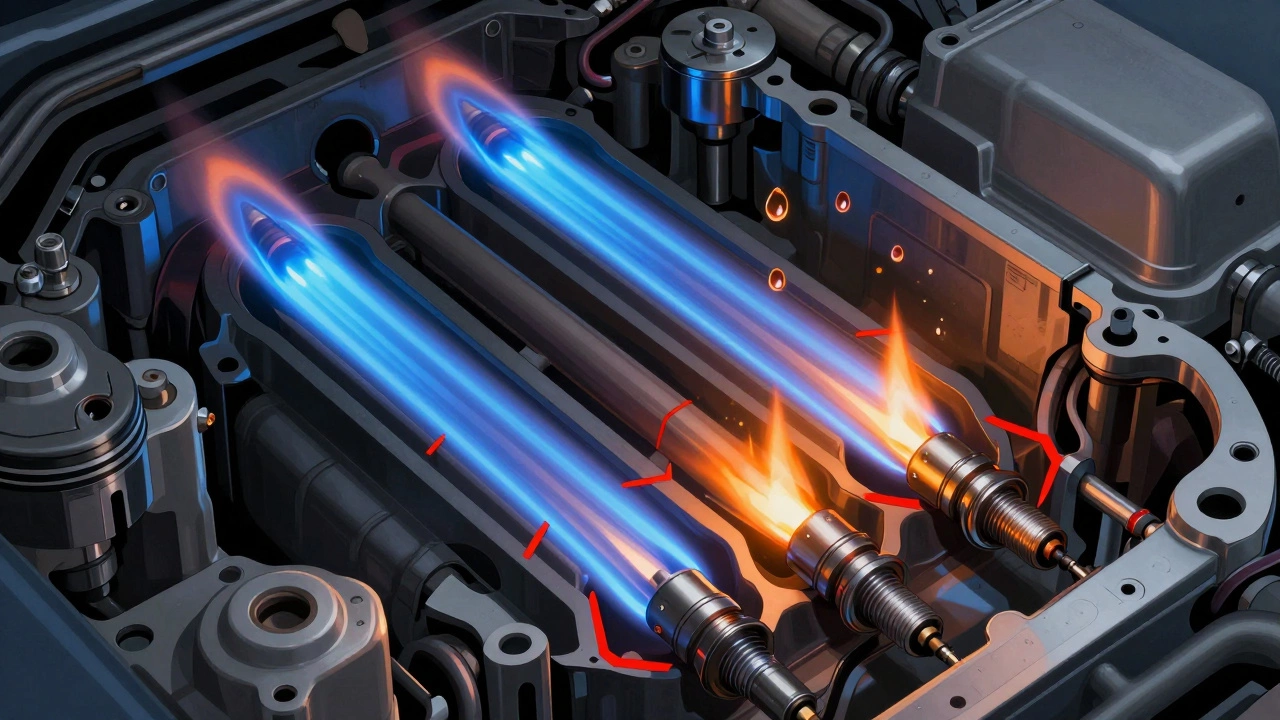
Think of your engine like a team. Each spark plug has one job: ignite the air-fuel mixture at the exact right moment. If one plug is new and the others are worn, they don’t perform the same way. The new plug fires hotter and more reliably. The old ones misfire, delay, or weakly spark. The result? Uneven combustion.
This imbalance causes:
- Engine misfires, especially under load
- Reduced fuel efficiency-you might see a 5% to 15% drop in MPG
- Increased emissions, which can fail your state inspection
- Strain on the catalytic converter, which can overheat and fail
- Odd vibrations or shaking at idle
A 2023 study by the Automotive Aftermarket Industry Association found that vehicles with mixed spark plug sets were 3.2 times more likely to trigger a persistent check engine light than those with full replacements. And in over 60% of those cases, the problem returned within 3,000 miles-even after clearing the code.
The Hidden Cost of Cutting Corners
Let’s say you have a six-cylinder engine. One spark plug costs $15. Replacing all six is $90. You think, “I’ll just replace the two that look bad. That’s $30 saved.” Sounds smart, right?
But here’s what usually happens next:
- Two weeks later, another plug fails. You go back to the shop.
- The mechanic says, “You need to replace the rest. And while you’re at it, we should check the coil packs-they’re stressed from the uneven firing.”
- Now you’re paying for labor twice. Plus, the new plug you installed earlier might be damaged from the misfires.
- Your fuel bill goes up. Your emissions test fails. Your catalytic converter starts to rattle.
By the time you fix everything, you’ve spent $250 instead of $90. And you’ve been driving with a damaged engine for weeks.
When You Might Get Away With Replacing Just One
There’s one real exception: if a single plug fails suddenly because of a mechanical issue-not normal wear. For example:
- Someone over-tightened it during a previous service and cracked the ceramic insulator.
- A coolant leak sprayed antifreeze onto the plug, causing it to short out.
- A faulty ignition coil fried one plug while the others are fine.
In those cases, replacing just the damaged plug is acceptable-but only if you fix the root cause. If you don’t, the new plug will fail again. And you’ll still be risking damage to the rest of the system.
Pro tip: If you’re replacing just one plug, always check the gap. Even new plugs can come pre-gapped incorrectly. Use a feeler gauge. Set it to the exact specification in your owner’s manual. A gap that’s too wide or too narrow can cause misfires-even on a brand-new plug.
What Mechanics Recommend (And Why)
Most ASE-certified mechanics will tell you: replace all spark plugs at the same time. Why? Because it’s faster, cheaper, and safer.
When you replace them all:
- You avoid multiple service visits
- You get consistent performance across all cylinders
- You reduce stress on the ignition coils and fuel system
- You prevent long-term damage to the catalytic converter
- You get a smoother, quieter engine that runs better and uses less fuel
Many shops even offer a discount on full spark plug sets. Some include free labor if you buy the plugs from them. That’s not a trick-it’s how they make money by doing the job right the first time.

How to Know When It’s Time to Replace Them
You don’t need to guess. Here’s how to tell for sure:
- Check your owner’s manual for the recommended interval
- Look for warning signs: rough idle, hesitation, poor acceleration, or the check engine light
- Have a mechanic pull one plug and inspect it-look for black soot (rich mixture), white deposits (overheating), or melted electrodes (too hot for the engine)
- Use an OBD2 scanner to read misfire codes (P0301, P0302, etc.). If you see more than one cylinder misfiring, it’s time for a full replacement
Don’t wait for all the plugs to fail. That’s like waiting for all your tires to blow out before replacing them.
What Type of Spark Plug Should You Use?
Not all spark plugs are created equal. Your car was designed for a specific type. Using the wrong one can cause serious problems.
Here’s a quick guide:
| Type | Lifespan | Best For |
|---|---|---|
| Copper | 20,000-30,000 miles | Older cars, low-cost replacements |
| Platinum | 60,000-100,000 miles | Most modern gas engines |
| Iridium | 80,000-120,000 miles | High-performance engines, turbocharged vehicles |
Always match the heat range and thread size. Using a plug that’s too hot can cause pre-ignition. Too cold, and it’ll foul with carbon. Stick to the OEM part number or a direct replacement from NGK, Denso, Bosch, or Champion.
Final Answer: No, Don’t Change Just Some
Is it OK to change only some spark plugs? Technically, yes-you can physically do it. But should you? No.
Replacing only a few plugs is a false economy. It might save you $30 today, but it risks $300 in repairs tomorrow. It’s like changing two tires on your car and leaving the other two bald. You might get to the next gas station-but you won’t get far without risking an accident.
Do it right. Replace the full set. Use the right type. Check the gap. And if you’re not sure, let a mechanic do it. The peace of mind, better fuel economy, and fewer breakdowns are worth every dollar.
Can I replace spark plugs one at a time as they fail?
No. Spark plugs wear out together because they operate under the same conditions. Replacing them one at a time creates imbalance in the engine, leading to misfires, poor fuel economy, and potential damage to the catalytic converter. Always replace them as a full set.
What happens if I mix different types of spark plugs?
Mixing plug types-like copper with iridium-can cause uneven firing, misfires, and engine damage. Each type has a different heat range, electrode design, and resistance. Your engine is tuned for one specific type. Stick to the manufacturer’s recommendation.
Do I need to replace spark plugs if my car runs fine?
Yes. Spark plugs can wear out without obvious symptoms. Even if your car runs smoothly, old plugs reduce fuel efficiency and increase emissions. Replace them at the interval listed in your owner’s manual-even if you don’t notice a problem.
How long do spark plugs last?
Copper plugs last 20,000-30,000 miles, platinum lasts 60,000-100,000 miles, and iridium can go up to 120,000 miles. Always follow your vehicle manufacturer’s recommendation, not the plug’s maximum lifespan.
Can a bad spark plug damage the engine?
Yes. A misfiring spark plug can cause unburned fuel to enter the exhaust system, overheating and destroying the catalytic converter. It can also lead to piston damage from detonation or pre-ignition if the plug is too hot for the engine. Don’t ignore a bad plug.
If you’ve been putting off replacing your spark plugs because you thought you could skip a few, stop now. Your engine doesn’t care about your budget-it only cares about balance. Give it the full set, and it’ll reward you with smooth power, better mileage, and years of reliable service.