Car AC Diagnostic Tool
Select the symptoms you are experiencing below to identify the likely cause and recommended action.
Air is warm or not cold
TemperatureAC blows air that feels like a hairdryer or ambient temp.
Weak Airflow
VolumeFan works but volume seems thinner or less forceful.
Hissing Sound
NoiseAudible escaping gas near dashboard or engine bay.
Grinding/Squealing Noise
MechanicalLoud mechanical noise from the engine compartment.
Ice on Vents/Coils
VisualVisible frost or ice forming inside the cabin or ductwork.
Diagnosis & Recommendation
Select symptoms above to see analysis.
It’s July in Manchester, and the last thing you want is for your car air conditioning to blow warm air when you’re stuck in traffic. You turn the dial to max cool, but all you get is a gentle breeze that feels more like a hairdryer on low heat. Before you drive to a mechanic and spend a fortune, you need to know if your system is actually running low on refrigerant-what most people still call freon.
Low refrigerant is one of the most common reasons for AC failure. It’s rarely a mechanical breakdown; it’s usually a slow leak. If you catch it early, you can save money and keep your cabin comfortable. Here is how to spot the symptoms, check the levels yourself, and decide whether to recharge or repair.
The Classic Signs Your AC Is Starving for Refrigerant
Your car’s AC system is a sealed loop. Under normal conditions, it should never lose gas. If the performance drops, something has leaked. You don’t need expensive tools to notice the first red flags. Pay attention to these physical changes in how your AC behaves.
Weak Airflow: This is often the first clue. The fan might be working fine, but the volume of air coming out of the vents seems thinner. It doesn’t hit your face with the same force. While this can sometimes mean a dirty cabin filter, combined with other symptoms, it points to low pressure in the system.
Next, look at the temperature. If the air starts cool but warms up after ten minutes, or if it’s only slightly cooler than the outside ambient temperature, your compressor isn’t doing its job. The compressor relies on sufficient refrigerant pressure to engage. When levels drop too low, the pressure switch cuts power to the compressor clutch to prevent damage. So, you hear the fan, but the compressor clicks off.
Listen closely while driving. A healthy AC system is relatively quiet. A system with low refrigerant often makes strange noises. You might hear a hissing sound near the dashboard or under the hood. This is the gas escaping from a leak. Alternatively, you might hear a grinding or squealing noise from the engine bay. This indicates the compressor is struggling because there isn’t enough lubricating oil circulating with the refrigerant.
Check the evaporator core inside your dashboard. If the refrigerant level is critically low, the temperature inside the system can drop below freezing. Moisture in the air condenses and freezes on the coils. You’ll see ice forming on the visible parts of the ductwork or hear a rattling sound as ice chips break loose. Once you turn the AC off, this ice melts, which can lead to water leaking onto your passenger-side footwell. Wet carpet is a major warning sign.
Visual Inspection: Finding the Leak Yourself
Refrigerant itself is invisible and odorless (mostly). However, modern systems contain a UV dye that glows bright yellow-green under black light. Many mechanics add this during service. If you have a UV flashlight, shine it around the AC components under the hood. Look at the connections between the high-pressure and low-pressure lines. Check the condenser, which sits right in front of the radiator. It’s exposed to road debris, so stones often puncture it.
If you don’t have a UV light, look for oily residue. Refrigerant carries oil with it. Wherever there is a leak, there will be an oily film on the metal fittings or hoses. Wipe the area clean with a rag, run the AC for five minutes, and wipe again. If the spot is oily again, you’ve found your leak.
Common leak points include:
- The condenser fins (front of the car)
- O-rings at the connection ports
- The compressor shaft seal
- Hoses that have hardened or cracked over time
Checking Pressure with a Manifold Gauge Set
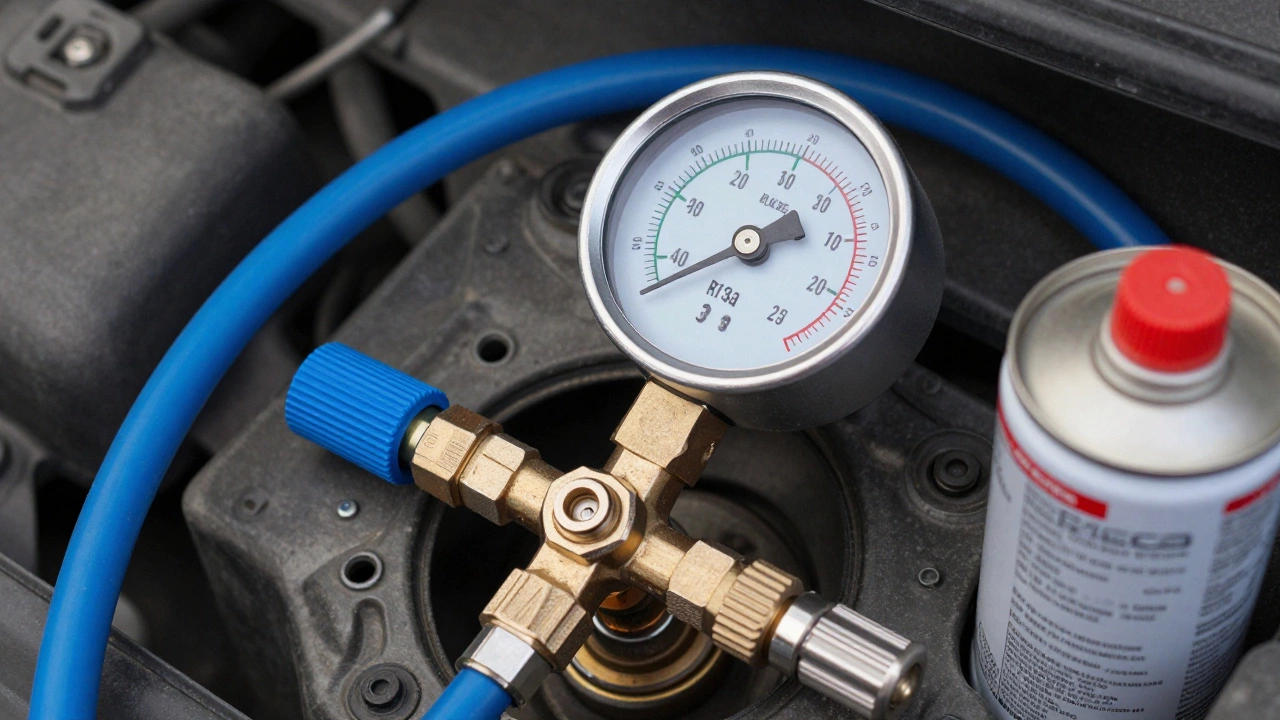
If visual checks aren’t enough, you need numbers. You can buy a simple AC manifold gauge set or a DIY recharge kit with a built-in gauge at any auto parts store. This is the only way to confirm low freon with certainty.
- Prepare the car: Park in a shaded area. Start the engine and let it idle. Turn the AC to maximum cool and set the fan to high. Open the windows briefly to equalize pressure if the car was hot.
- Locate the ports: Open the hood and find the AC lines. One is thick (low-pressure) and one is thin (high-pressure). They have caps on them. Do not mix them up. The low-pressure port usually has a blue cap, and the high-pressure port has a red cap.
- Connect the gauge: Unscrew the low-pressure cap and attach the blue hose of your gauge set. Tighten it snugly.
- Read the value: Watch the gauge needle. For R134a systems (most cars made before 2017), the ideal low-side pressure is between 25 and 40 PSI when the engine is idling. For R1234yf systems (newer cars), the pressures are different, so check your specific vehicle’s manual.
If the reading is below 25 PSI, your system is low. If the needle stays at zero, you might have a massive leak or a broken compressor. Do not keep adding refrigerant if the pressure doesn’t rise. You could be masking a serious mechanical failure.

R134a vs. R1234yf: Know Your Refrigerant
You cannot just grab any can of AC refill. Using the wrong type can destroy your system. Cars manufactured roughly between 1994 and 2016 use R134a (Tetrafluoroethane). Newer vehicles, especially those sold in Europe and the US after 2017, use R1234yf (2,3,3,3-Tetrafluoropropene).
Why the change? R134a has a high global warming potential. Regulations forced the industry to switch to R1234yf, which breaks down much faster in the atmosphere. The two gases are not compatible. Their service ports have different thread sizes to prevent accidental mixing. If you put R134a into an R1234yf system, the sensors will read incorrectly, and the performance will be terrible. Always check the sticker under your hood or in your glovebox to identify the correct refrigerant.
Should You Recharge It Yourself?
DIY AC recharge kits are popular because they are cheap. You buy a can, attach it to the low-pressure port, and shake it in. But here is the catch: refrigerant does not get "used up." It circulates. If you need to add it, you have a leak.
Adding refrigerant without fixing the leak is a temporary band-aid. You will likely need to top it up every few months. Worse, overcharging the system can cause high pressure, leading to compressor failure. Compressors are expensive to replace. If your gauge shows low pressure, consider the cost of a professional leak test. A shop uses nitrogen and electronic sniffers to find tiny leaks that UV dye misses. Fixing a small O-ring costs far less than replacing a blown compressor.
If you choose to DIY, follow these rules:
- Never charge the high-pressure side.
- Add refrigerant slowly while the engine is running.
- Stop when the pressure reaches the recommended range for the current outdoor temperature.
- Dispose of empty cans properly. They are pressurized containers.
When to See a Professional
Some problems require expert tools. If you hear clicking from the compressor clutch, the electrical system or the clutch coil might be faulty. If the AC blows cold for a few seconds then stops, the thermal fuse inside the compressor may have tripped due to overheating. These issues won’t be fixed by adding freon.
Also, if your car uses R1234yf, DIY refills are harder to find and more expensive. The equipment required to handle this gas is specialized. In these cases, visiting a certified technician is safer and often more cost-effective in the long run.
| Symptom | Likely Cause | Action |
|---|---|---|
| Air is warm | Low refrigerant or compressor failure | Check pressure gauges |
| Hissing noise | Active leak | Find leak with UV dye |
| Ice on vents | Critical low refrigerant | Turn off AC, seek repair |
| Grinding sound | Compressor bearing wear | Professional inspection needed |
| Weak airflow | Cabin filter or blower motor | Replace cabin filter first |
Frequently Asked Questions
Can I drive with low freon in my car AC?
Yes, you can drive safely, but your cabin comfort will suffer. Driving with low refrigerant does not directly damage the engine, but it can harm the AC compressor. The compressor needs refrigerant to lubricate its internal parts. Running it dry for extended periods can cause the bearings to seize, leading to a costly replacement. It is best to fix the leak and recharge the system soon.
How much does it cost to recharge car AC freon?
A DIY recharge kit costs between £20 and £40. A professional recharge at a garage typically ranges from £80 to £150, depending on the amount of refrigerant needed and labor rates. If a leak repair is required, such as replacing a condenser or O-rings, the total bill can rise to £200-£400. Always ask for a quote that includes both the leak detection and the recharge.
Does AC freon ever just disappear without a leak?
No. The AC system is a closed loop. Refrigerant does not burn up or get consumed like fuel. If the pressure drops, there is always a leak, no matter how small. Even microscopic pores in old rubber hoses can allow gas to escape over several years. Assuming it "just went away" will lead to repeated recharges without solving the root problem.
What happens if I overcharge my AC with freon?
Overcharging causes high pressure in the system. This reduces cooling efficiency because the liquid refrigerant cannot expand properly in the evaporator. The compressor has to work harder, generating excess heat. In severe cases, the high-pressure switch will cut the system off to protect the compressor. If ignored, it can cause seals to fail or pipes to burst. Always use a gauge to monitor pressure during recharge.
Is freon toxic or dangerous to humans?
Modern refrigerants like R134a and R1234yf are non-toxic and non-flammable in typical exposure scenarios. However, they are heavy gases that can displace oxygen in confined spaces. Inhaling large amounts directly from a can can cause dizziness, nausea, or heart irregularities. Always work in a well-ventilated area and avoid direct skin contact with the cold gas, which can cause frostbite. Dispose of empty cans responsibly.
How do I know if my AC needs R134a or R1234yf?
Check the label under your hood near the AC lines. It will clearly state the required refrigerant type. You can also look at the service port caps. R134a systems usually have larger, threaded ports, while R1234yf systems have smaller, proprietary quick-connect fittings. Using the wrong type will not fit or will damage the system. Consult your owner’s manual if the sticker is faded or missing.