Fuel Pump Diagnostic Assistant
Step 1: The No-Prime Test
This is the easiest check. Modern cars prime the fuel system when you turn the key.
- ✓ Open driver's door and sit inside.
- ✓ Turn key to "On" (do not start).
- ✓ Listen near the rear tank area.
Step 2: Fuse & Relay Check
Rule out cheap parts before replacing expensive ones.
- Locate the fuse box (under hood or dash).
- Find the "Fuel Pump" fuse. Inspect for breaks.
- The Swap Trick: Swap the fuel pump relay with an identical one (like the horn). If the pump hums now, the relay was bad.
Step 3: Fuel Pressure Test
The gold standard. You need a fuel pressure gauge and access to the Schrader valve on the fuel rail.
Step 4: Voltage Drop Test
Corroded wires can starve the pump of power.
- Set multimeter to DC Volts.
- Back-probe the pump connector while cranking.
- Target: Close to 12V.
- Warning: Below 10V indicates a wiring issue.
Step 5: Direct Power Test
The definitive test. Bypass the car's wiring using jumper wires directly from the battery.
If the pump spins loudly and smoothly with direct power, the pump is good (problem is wiring/relay). If it sputters or does nothing, replace the pump.
Your car is parked. You turn the key, and instead of that familiar rumble, you get silence-or worse, a frantic clicking sound. The engine cranks but refuses to catch. It’s a frustrating moment, and your first thought might be the battery or the starter. But if those are fine, the culprit is often hiding in your gas tank: a failing fuel pump.
A bad fuel pump doesn’t always die all at once. Sometimes it gives you warnings weeks before it quits completely. Knowing how to spot these signs and run a few simple tests can save you from being stranded on the side of the road. You don’t need a degree in automotive engineering to figure this out. With a few basic tools and some patience, you can diagnose the problem yourself.
The Symptoms: Is Your Fuel Pump Acting Up?
Before you start poking around with wires and gauges, look at how your car has been behaving lately. A failing fuel pump usually shows its hand through specific behaviors. If you notice one or more of these, your suspicion should rise immediately.
- Engine Sputtering at High Speeds: This is one of the most common early signs. When you’re cruising on the highway, the engine needs a steady stream of fuel. If the pump is weak, it can’t keep up with demand. The result? The car feels like it’s running out of gas every few seconds, surging forward and then stumbling.
- Loss of Power Under Load: Try accelerating hard or climbing a steep hill. Does the car feel sluggish, like it’s dragging an anchor? A healthy pump delivers high pressure; a dying one struggles when the throttle opens wide.
- Overheating Engine: It sounds weird, but a lean fuel mixture (too much air, not enough fuel) caused by low pressure can make the engine run hotter than usual. Check your temperature gauge.
- Car Won’t Start: This is the final stage. If the pump dies completely, no fuel reaches the injectors. The engine will crank endlessly but never fire up.
- Whining Noise from the Tank: Listen closely when you first turn the key. You should hear a faint hum from the rear of the car. If it sounds like a jet engine taking off, the pump motor is likely wearing out.
If any of these ring a bell, it’s time to move from observation to diagnosis.
Step 1: The "No-Prime" Test (The Easiest Check)
Modern cars have a built-in diagnostic feature that most drivers ignore. When you turn the ignition to the "On" position (before starting the engine), the fuel pump should prime itself for two to three seconds. This builds up initial pressure so the engine starts quickly.
Here is how to perform this test:
- Open the driver’s door and sit inside.
- Turn the key to the "On" position. Do not start the engine yet.
- Listen carefully near the rear of the vehicle (where the fuel tank is).
- You should hear a distinct humming or whirring noise for about two seconds, then silence.
If you hear nothing, the pump isn’t getting power, or it’s dead. If you hear a loud grinding or screeching noise, the internal bearings are shot. In either case, the pump is likely the problem. However, absence of noise doesn’t always mean a bad pump-it could be a blown fuse or a bad relay. That brings us to the next step.
Step 2: Check the Fuse and Relay
Before replacing an expensive part, rule out the cheap stuff. The fuel pump is protected by a fuse and controlled by a relay. If either fails, the pump gets zero power.
Locate your fuse box. In most cars, there are two: one under the hood and one inside the cabin (usually under the dashboard or near the kick panel). Consult your owner’s manual to find the specific fuse labeled "Fuel Pump" or "FP." Pull it out and inspect the metal strip inside. If it’s broken or blackened, replace it with a new one of the same amperage rating.
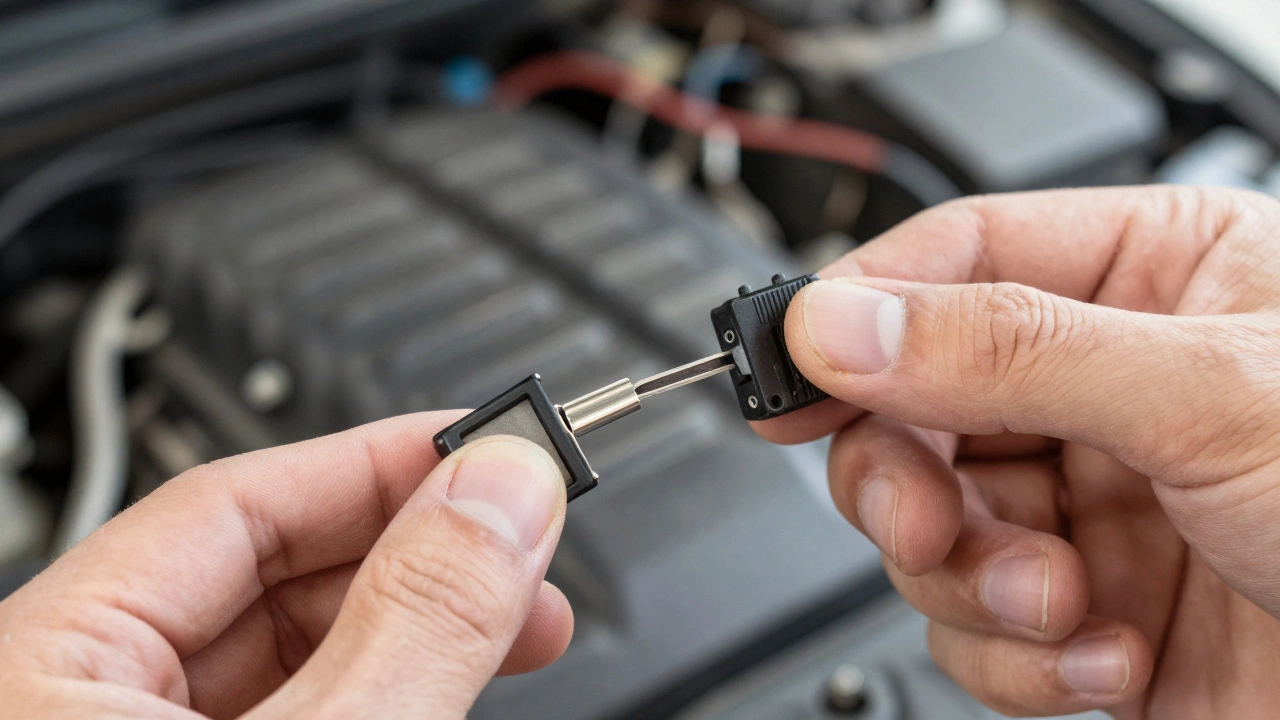
Next, check the fuel pump relay. Relays are small, cube-shaped boxes in the fuse box. They often share the same shape and pin configuration as other relays (like the horn or AC relay). Here’s a trick: swap the fuel pump relay with another identical relay (like the horn relay). Turn the key to "On." If you now hear the pump humming, your original relay was bad. If it’s still silent, the issue lies elsewhere-likely the pump itself or the wiring.
Step 3: The Fuel Pressure Test (The Gold Standard)
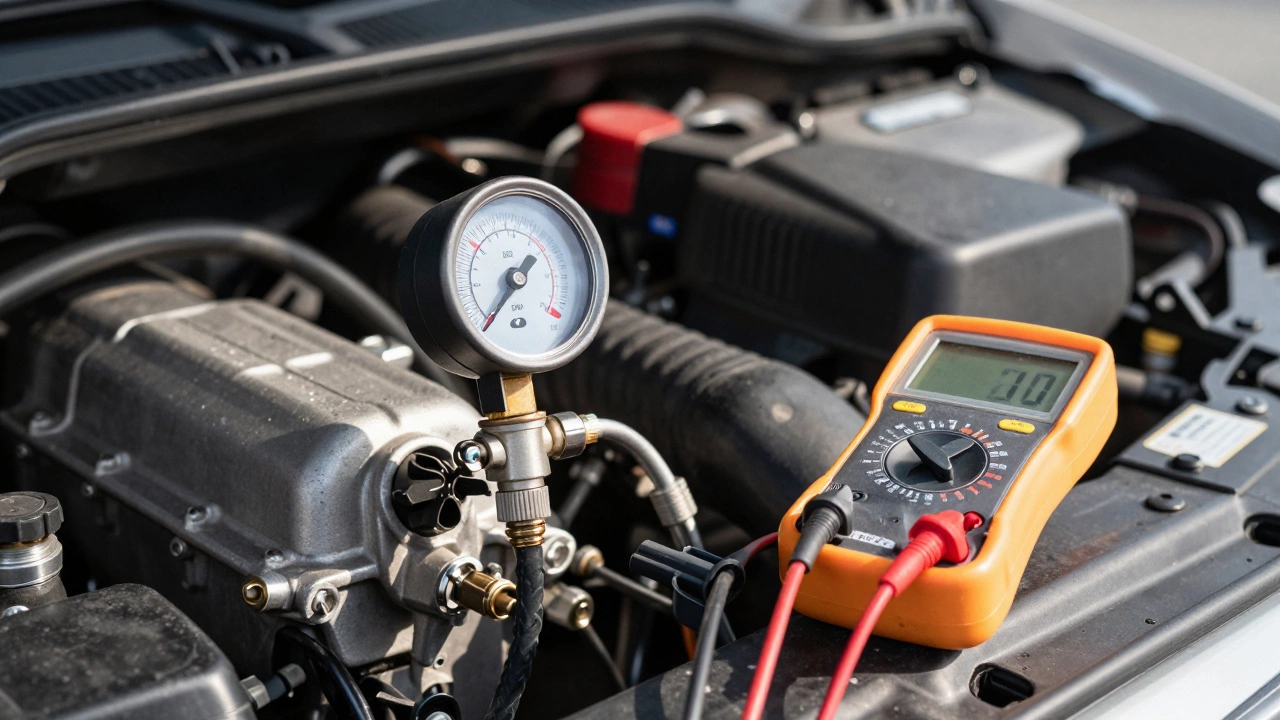
If the fuse and relay are good, you need to measure the actual pressure. This requires a fuel pressure gauge a tool used to measure the force at which fuel is delivered to the engine. You can rent one from most auto parts stores for free if you buy a filter, or borrow one from a friend.
Every car has a Schrader valve on the fuel rail (the metal pipe that runs along the top of the engine where the injectors plug in). It looks exactly like the valve on your tire.
Follow these steps carefully:
- Relieve Residual Pressure: Disconnect the fuel pump fuse. Start the car and let it run until it stalls. This bleeds off dangerous pressure in the lines. Reconnect the fuse afterward.
- Connect the Gauge: Remove the protective cap from the Schrader valve on the fuel rail. Screw the fuel pressure gauge onto the valve tightly.
- Crank the Engine: Have a helper turn the key to "Start" for a few seconds. Watch the gauge needle.
- Read the Value: Compare the reading to your vehicle’s specifications. Most gasoline engines require between 30 and 60 PSI (pounds per square inch). Diesel engines operate at much higher pressures, often hundreds of PSI.
If the pressure is below the manufacturer’s spec, the pump is weak. If there is no pressure at all, the pump is dead or the fuel filter is clogged. Always check the fuel filter first-it’s cheaper and easier to replace.
Step 4: The Voltage Drop Test
Sometimes the pump is fine, but it’s not getting enough electricity to run properly. Corroded connectors or long, thin wires can cause a voltage drop. The pump might receive only 9 volts instead of the required 12, causing it to run slow and overheat.
To test this, you’ll need a multimeter:
- Locate the electrical connector for the fuel pump. On many cars, this is accessible via an access panel under the rear seat or trunk carpet.
- Set your multimeter to DC Volts.
- Back-probe the connector pins (insert the probes gently behind the wires without damaging them) while someone turns the key to "On".
- Check the voltage. It should read close to 12 volts. If it reads below 10 volts, you have a wiring issue, not necessarily a pump issue.
Step 5: The Direct Power Test
This is the definitive test. If you suspect the pump is bad, but want to be 100% sure before dropping money on a replacement, bypass the car’s wiring entirely.
Warning: This involves working with flammable fuel vapors. Work in a well-ventilated area, away from sparks or open flames.
- Access the fuel pump module in the tank (often under the rear seat).
- Disconnect the factory wiring harness.
- Use a pair of jumper wires connected directly to the battery terminals.
- Tap the positive jumper wire to the positive terminal on the pump connector, and the negative to the ground.
If the pump spins loudly and smoothly, the pump is good, and your problem is in the wiring or relay. If it sputters, makes grinding noises, or does nothing, the pump is dead. Replace it immediately.
| Symptom | Likely Cause | Action |
|---|---|---|
| No hum when key is turned | Blown fuse, bad relay, or dead pump | Check fuse/relay first, then test pump voltage |
| Low pressure reading | Weak pump or clogged filter | Replace fuel filter, then re-test pressure |
| High-pitched whine | Pump cavitation or wear | Inspect fuel level sensor and pump impeller |
| Car dies at idle | Intermittent pump failure | Perform vibration test (tap pump while running) |
When to Call a Professional
While testing the fuse, relay, and even the pressure is DIY-friendly, removing the fuel pump itself can be tricky. On some vehicles, it’s under the rear seat. On others, you have to dig out the entire tank from underneath the car. If you don’t have a jack, stands, and the right tools, leave the removal to a mechanic. Also, if your car uses a complex electronic control module (ECM) to regulate pump speed, diagnosing wiring issues may require specialized scan tools.
How much does it cost to replace a fuel pump?
Costs vary widely depending on your vehicle. For a standard sedan, parts alone range from $100 to $400. Labor can add another $200 to $600 if the pump is difficult to access. Luxury brands or trucks with large tanks may see total costs exceed $1,000.
Can a bad fuel pump damage the engine?
Indirectly, yes. A failing pump causes a lean fuel mixture, which makes the engine run hot. Over time, excessive heat can damage pistons, valves, and catalytic converters. It’s best to address pump issues promptly to avoid costly secondary repairs.
How long does a fuel pump last?
Most fuel pumps are designed to last the life of the vehicle, typically 100,000 to 150,000 miles. However, running the tank frequently below a quarter full can shorten lifespan because the fuel cools and lubricates the pump. Keeping the tank above half-full helps extend its life.
Why does my car stall when I hit a bump?
This is often a sign of a worn fuel pump pickup tube or a loose connection. As the car moves, the pump loses contact with the fuel or the electrical connector wiggles loose. Inspect the pump assembly and wiring harness for secure connections.
Can I drive with a bad fuel pump?
It is not recommended. Driving with a weak pump risks stalling in traffic, which is dangerous. It also puts extra strain on the engine due to lean conditions. If the pump fails completely, you will be stranded. Replace it as soon as symptoms appear.