Car Battery Life Estimator
Enter your details to see an estimate of your battery's remaining lifespan and risk level.
You’re standing in a cold Manchester morning, key in hand, and the engine just clicks. It’s not dead; it’s just tired. Most drivers think batteries die from old age alone, but that’s only half the story. A car battery is a chemical storage device designed to deliver high current for short bursts, typically lasting three to five years under ideal conditions. However, real-world habits and environmental factors can slash that lifespan in half.
If you want your battery to last as long as the manufacturer claims, you need to stop treating it like a disposable part and start understanding what actually kills it. It’s rarely one big event. Usually, it’s a slow accumulation of small stresses-heat cycles, electrical leaks, and poor charging habits-that degrade the internal plates until they simply can’t hold a charge anymore.
The Silent Killer: Parasitic Drain
Imagine leaving a tap running slightly overnight. You might not notice it at first, but by morning, the tank is empty. That’s exactly what parasitic drain does to your battery. This is an unwanted flow of electricity when the ignition is off. Modern cars are rolling computers with dozens of modules staying awake to listen for remote signals, clock settings, or alarm triggers.
While a healthy alternator replenishes the battery while you drive, a significant drain prevents full recovery during short trips. Common culprits include aftermarket dashcams wired incorrectly, faulty glove box lights that stay on, or even a malfunctioning trunk light. If your car sits unused for more than two weeks, this constant sipping can drop the voltage below 12.4 volts, causing sulfation-a process where lead sulfate crystals harden on the battery plates, permanently reducing capacity.
Temperature Extremes: Heat vs. Cold
Here’s a counterintuitive fact: heat kills batteries faster than cold. While cold weather makes starting difficult because the oil thickens and chemical reactions slow down, extreme heat accelerates the evaporation of electrolyte fluid and corrodes internal components. In hot climates, or if your engine bay runs particularly hot due to poor ventilation, the battery’s internal structure breaks down rapidly.
| Condition | Effect on Battery | Lifespan Impact |
|---|---|---|
| Ideal (20°C / 68°F) | Optimal chemical balance | Baseline (3-5 years) |
| Extreme Heat (>35°C / 95°F) | Electrolyte evaporation, plate corrosion | Reduces life by up to 50% |
| Extreme Cold (<-10°C / 14°F) | Slowed reaction, increased viscosity | Harder starting, temporary capacity loss |
Cold doesn’t destroy the battery immediately; it just reveals how weak it already is. If your battery was damaged by summer heat, winter will expose the weakness by demanding more power to turn over a frozen engine. Protecting your battery from direct sunlight and ensuring proper engine cooling helps mitigate this thermal stress.

Short Trips and Undercharging
Do you mostly drive to the shops and back? Your battery might be starving. The alternator needs time to recharge the energy used to start the engine. Typically, it takes about 15 to 20 minutes of steady driving to fully replenish a standard starter motor draw.
If your daily commute is five minutes each way, the battery never reaches 100% state of charge. Over months, this chronic undercharging leads to stratification, where the acid settles at the bottom of the cells, leaving the top layers diluted. This imbalance causes uneven wear on the plates. If you live in a city like Manchester with frequent short urban hops, consider using a smart charger once a month to bring the battery back to full health.
Vibration and Physical Damage
Batteries hate shaking. Inside a standard flooded lead-acid battery, active material is pasted onto lead grids. Constant vibration from rough roads, loose mounts, or aggressive driving can shake this material off the grids. Once the material falls, it piles up at the bottom of the case. If enough debris accumulates, it bridges the gap between positive and negative plates, causing an internal short circuit.
This is why securing the battery tray is critical. A rattling battery isn’t just annoying; it’s dying. Check the hold-down clamp regularly. If it’s loose, tighten it. If the rubber feet are worn out, replace them. For vehicles with sensitive electronics or those driven on unpaved roads, an AGM (Absorbent Glass Mat) battery is often a better choice because its glass mat separators resist vibration damage much better than traditional liquid electrolytes.
Neglected Maintenance and Corrosion
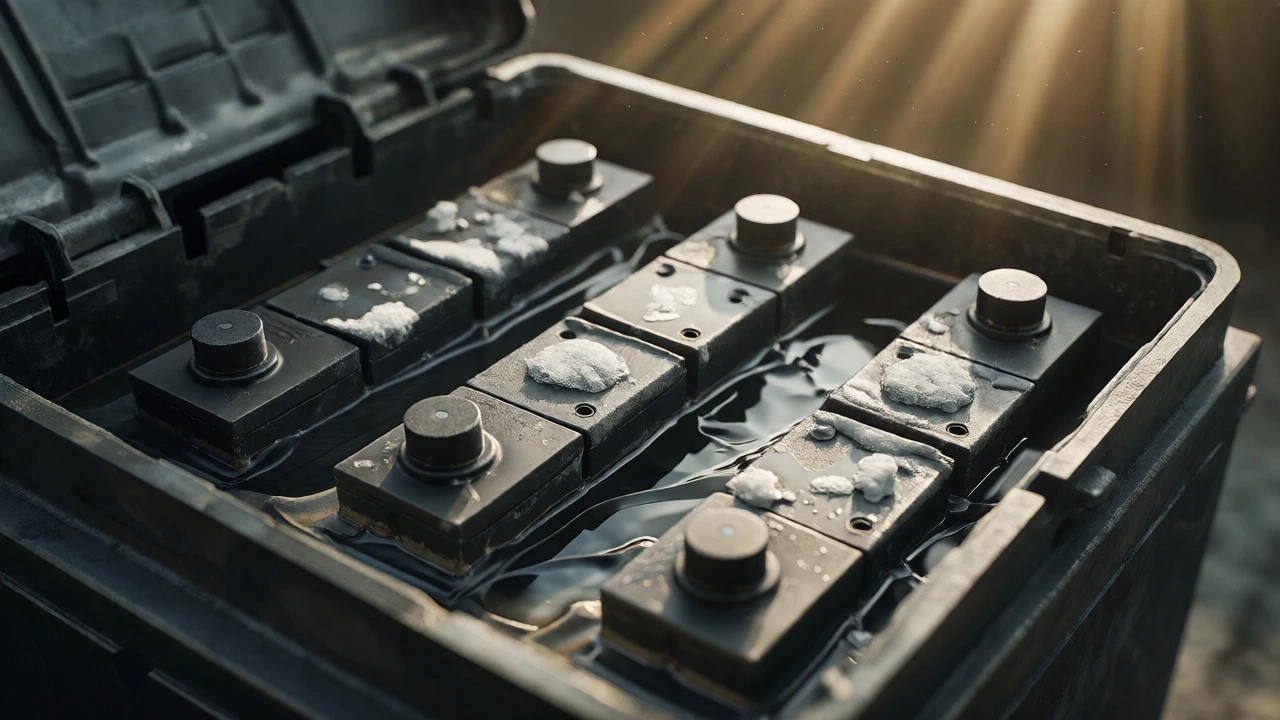
You don’t need to be a mechanic to spot trouble. Look at the terminals. White or blue crusty buildup is lead sulfate corrosion. This layer acts as an insulator, increasing resistance. Higher resistance means the starter motor has to work harder, drawing more current and generating more heat, which further degrades the battery.
Cleaning terminals is simple. Disconnect the negative terminal first, scrub with a wire brush, apply a thin layer of petroleum jelly or specialized terminal grease, and reconnect. Doing this every six months ensures efficient power transfer. Also, check the battery case itself. Cracks allow electrolyte to leak out, lowering the level below the plates and exposing them to air, which ruins them instantly.
How to Extend Your Battery’s Life
You can’t control the weather, but you can control how you treat your car. Here is a practical checklist to keep your battery healthy:
- Limit Electrical Load When Engine is Off: Avoid listening to the radio or charging phones with the engine off for extended periods.
- Take Longer Drives: Try to take one highway drive per week for at least 30 minutes to let the alternator do a deep charge.
- Check Voltage Regularly: Use a multimeter. A resting voltage below 12.4V indicates a problem. Above 12.6V is healthy.
- Secure the Mount: Ensure the battery doesn’t move more than a millimeter when you push it by hand.
- Clean Terminals: Remove corrosion before it blocks the connection.
If you suspect your battery is failing, don’t wait for the click of death. Many auto parts stores offer free testing. They measure both voltage and Cold Cranking Amps (CCA). A battery might show 12.5V but fail the load test, meaning it can’t deliver the punch needed to start the engine. Catching this early saves you from being stranded.
How long should a car battery last?
Most standard lead-acid car batteries last between three and five years. However, this varies significantly based on climate, driving habits, and vehicle electrical demands. Extreme heat and frequent short trips can reduce this lifespan to as little as two years.
Does idling charge the car battery?
Yes, idling charges the battery, but less efficiently than driving. At idle, the alternator produces lower amperage. If your car has many electrical accessories running (AC, heated seats, infotainment), the net charge may be minimal or even negative. Driving at higher RPMs generates more power for faster charging.
Can I jump-start a bad battery repeatedly?
You can, but it’s risky. Repeatedly jumping a deeply discharged or sulfated battery can damage the alternator or the vehicle’s computer modules due to voltage spikes. If you find yourself jumping the car more than twice in a week, the battery likely needs replacement rather than just a charge.
What is parasitic drain and how do I test it?
Parasitic drain is electricity drawn from the battery when the car is off. To test it, disconnect the negative battery cable, set a multimeter to amps, and connect it between the negative post and the cable clamp. A normal draw is under 50 milliamps (0.05A). Anything higher suggests a component is staying on unexpectedly.
Is an AGM battery worth the extra cost?
For modern cars with Start-Stop technology or high electrical loads, yes. AGM (Absorbent Glass Mat) batteries handle deeper discharges and recharge faster than flooded lead-acid batteries. They are also more resistant to vibration and temperature extremes, often lasting longer in demanding conditions despite the higher upfront price.