Oil Top-Up Calculator
Step 1: Assess Current Status
Visualizer & Recommendation
RECOMMENDED ACTION
That little warning light on your dashboard isn't just a suggestion. It’s a panic button for your engine. If you see it, or if your dipstick looks bare, the immediate question is usually: "How much do I pour in?" The answer isn't a single number like "one quart." It depends entirely on where your current level sits and what your car actually holds. Pouring too little leaves metal grinding against metal. Pouring too much can blow seals or foam the oil, causing just as much damage.
You don't need a mechanic to fix a low oil situation, but you do need to be precise. This guide walks you through checking the level accurately, calculating exactly how much to add, and avoiding the common mistakes that turn a simple top-up into an expensive repair bill.
The Quick Summary
- Check before you guess: Always use the dipstick to determine the exact gap between the current level and the 'Full' mark.
- The One-Quart Rule: For most cars, adding one quart (approx. 1 liter) raises the level from 'Low' to 'Full.' Start with half a quart if you are unsure.
- Match the Viscosity: Use the exact oil grade specified in your owner's manual (e.g., 5W-30). Mixing different types can degrade performance.
- Slow and Steady: Add oil gradually. Wait two minutes after pouring to let it settle before re-checking the dipstick.
- Never Overfill: Exceeding the 'Full' mark can cause engine hydro-lock or seal failure. If you overfill, drain the excess immediately.
Understanding Your Engine's Oil Capacity
Before you buy a bottle of oil, you need to know two numbers: the total capacity and the fill quantity. These are not always the same. Total Oil Capacity is the maximum amount of oil your engine can hold when completely empty, including the filter. However, when you change your oil, some old oil always remains in the galleries and crankcase. Therefore, the fill quantity-what you actually pour in during a standard change-is usually less than the total capacity.
Why does this matter for topping up? Because you aren't filling an empty engine. You are filling the gap left by consumption or a small leak. Most modern passenger cars hold between 4 to 6 liters (roughly 4.5 to 6.5 quarts) of oil. Larger SUVs or trucks might hold 7 to 8 liters. High-performance engines with dry sumps can vary wildly.
To find your specific numbers, check your owner's manual. Look for the section titled "Fluid Capacities" or "Specifications." If you don't have the manual, search online for "[Your Car Year] [Make] [Model] oil capacity." Do not guess based on similar models; engine designs vary significantly even within the same brand.
How to Check the Oil Level Accurately
You cannot add the right amount of oil if you don't know how much is missing. The dipstick is your primary tool, but it is often misused. Here is the correct procedure to get a true reading:
- Park on Level Ground: An inclined car will pool oil in one corner of the pan, giving a false high or low reading.
- Cool Down: Turn off the engine and wait at least 5 to 10 minutes. This allows the oil to drain back down from the upper galleries into the sump. Checking hot oil immediately after driving can result in a dangerously low reading because the oil hasn't settled.
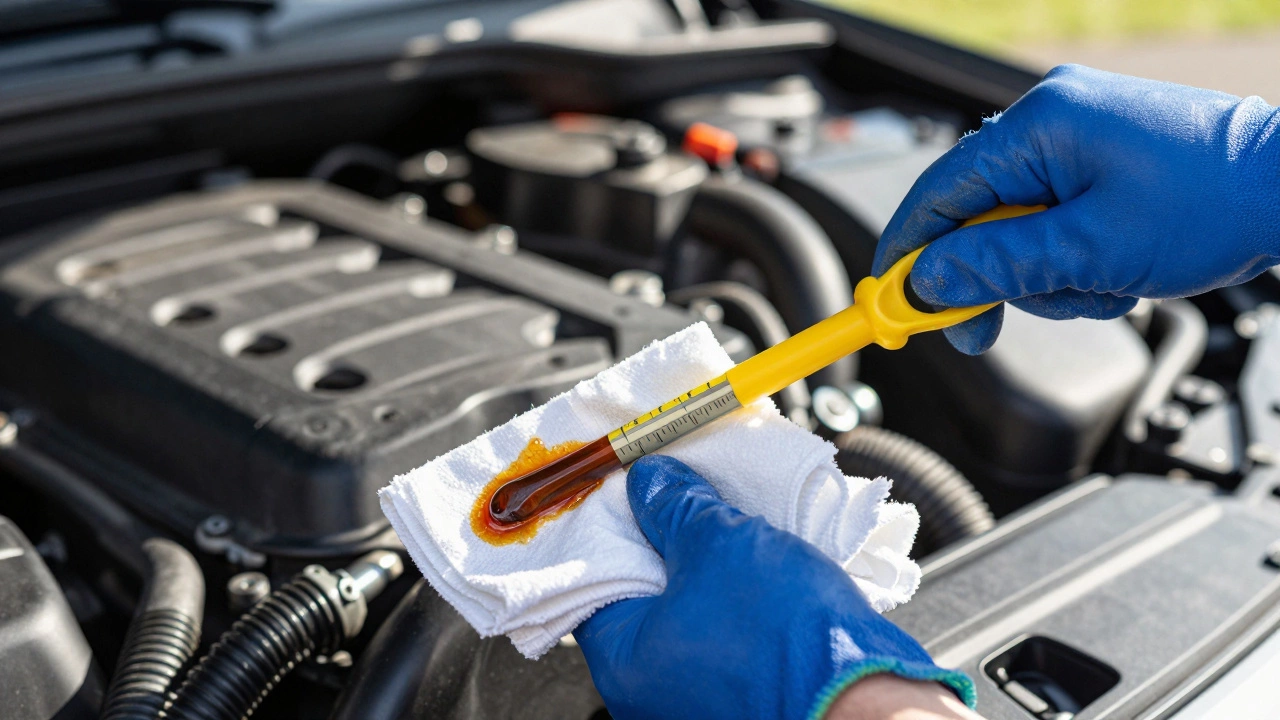
- Locate the Dipstick: It usually has a yellow or orange handle labeled "Oil." Pull it out completely.
- Wipe Clean: Use a clean rag or paper towel to wipe the entire stick clean. Oil splashed on the side during driving can trick you into thinking the level is higher than it is.
- Re-insert Fully: Push the dipstick back in all the way until it seats firmly.
- Read the Level: Pull it out again and look at the end. There will be two marks: a lower hole or line (Min/Low) and an upper hole or line (Max/Full). The oil should be between these two marks.
If the oil is below the bottom mark, your engine is critically low. If it is halfway between the marks, you have room to breathe but should top up soon. If it is at the top mark, do not add any more oil.
Calculating How Much Oil to Add
This is the core of your question: "How much?" Since we established that you can't just dump a whole bottle in, you need a strategy. The general rule of thumb in the automotive industry is that one quart (approximately 0.95 liters) of oil typically moves the dipstick reading from the 'Low' mark to the 'Full' mark in most standard four-cylinder and six-cylinder engines.
However, relying solely on this rule can be risky if you are close to the full mark already. Here is a safer approach:
| Dipstick Status | Action Required | Amount to Add (Approx.) |
|---|---|---|
| No Oil Visible | Critical - Add Immediately | Start with 1 Liter (1 Quart) |
| At 'Low' / Min Mark | Top Up Soon | 0.5 to 1 Liter (0.5 to 1 Quart) |
| Halfway Between Marks | Maintenance Check | 0.25 to 0.5 Liters (0.25 to 0.5 Quarts) |
| Near 'Full' / Max Mark | Do Not Add | 0 Liters |
The Strategy: If you are at the 'Low' mark, pour in about half a quart (or 0.5 liters). Wait two minutes. Re-check the dipstick. If it's still low, add another half quart. This incremental method prevents overfilling. It is better to check three times than to flood the engine once.
Choosing the Right Oil Type
Adding the wrong type of oil can negate the benefits of topping up. You must match the viscosity and specification recommended by your manufacturer. This information is found on the oil filler cap itself or in the owner's manual.
Viscosity Grade is a measure of the oil's thickness and flow characteristics at different temperatures, denoted by codes like 5W-30 or 0W-20. The first number (before the W) indicates cold-flow ability. The second number indicates thickness at operating temperature. Using 10W-40 in an engine designed for 0W-20 can cause poor lubrication during startup and increased fuel consumption.
Additionally, check for API service categories (like SN Plus or SP) or ACEA standards (like A5/B5). Modern direct-injection engines often require oils with Low SAPS (Sulfated Ash, Phosphorus, Sulfur) to protect catalytic converters and particulate filters. Using conventional oil in a car requiring synthetic blend can lead to sludge buildup over time.

The Dangers of Overfilling
Most people fear running out of oil, but overfilling is equally dangerous and often overlooked. When the oil level exceeds the 'Full' mark, the rotating crankshaft dips into the liquid oil. This creates aeration, turning the oil into a frothy foam.
Foamy oil cannot lubricate effectively. It compresses under pressure rather than forming a protective film between moving parts. This leads to increased wear on bearings and camshafts. In severe cases, the aerated oil can block the oil pump pickup screen, leading to complete oil starvation and catastrophic engine failure within minutes.
Furthermore, excessive oil increases internal pressure. This can force oil past seals and gaskets, leading to leaks from the valve cover, rear main seal, or oil pan. If you accidentally overfill, do not drive the car. You must drain the excess oil through the dipstick tube using a suction pump or by removing the drain plug slightly. It is a minor inconvenience compared to replacing an engine.
When Topping Up Isn't Enough
If you find yourself needing to add oil every week or month, you have a problem. Engines do consume small amounts of oil through normal combustion (burn-off) and seepage, but significant loss indicates a fault.
Common causes include:
- Worn Piston Rings: Allows oil to enter the combustion chamber, often visible as blue smoke from the exhaust.
- Leaking Seals: Valve stem seals or crankshaft seals may be hardened or cracked.
- PCV Valve Failure: A stuck Positive Crankcase Ventilation valve can increase pressure and force oil out of breathers.
If your oil consumption exceeds 1 quart per 1,000 miles (approx. 1 liter per 1,600 km), consult a mechanic. Continuing to top up without addressing the root cause will eventually lead to major repairs.
Step-by-Step Top-Up Procedure
Here is the final checklist for safely adding oil to your vehicle:
- Gather Supplies: Correct oil type, funnel, rag, and gloves.
- Open Hood: Locate the oil filler cap (usually black or grey, labeled "Engine Oil"). Remove it.
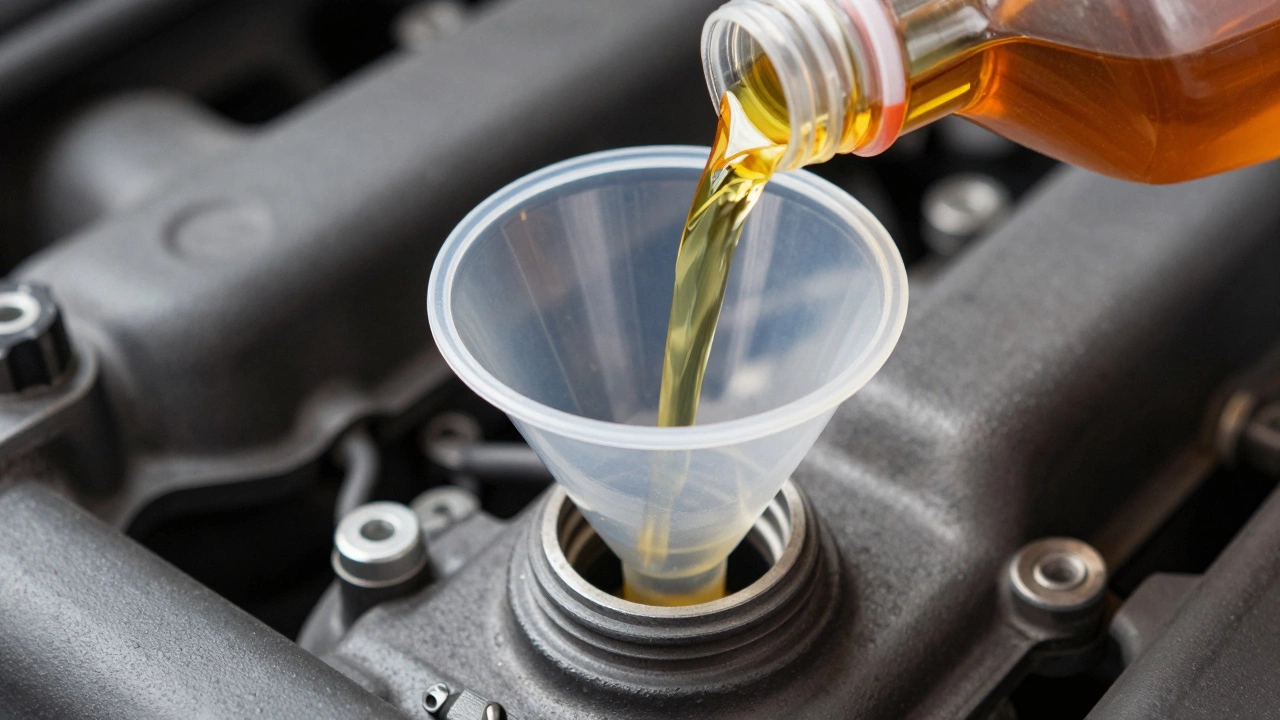
- Insert Funnel: Place the funnel securely into the opening to prevent spills on hot engine components.
- Pour Slowly: Add the calculated amount (start with 0.5 liters/quarts).
- Wait: Replace the cap and wait 2-3 minutes for the oil to settle in the pan.
- Re-Check: Pull the dipstick, wipe, re-insert, and read again.
- Repeat if Necessary: If still low, add small increments (0.25 liters) until the level reaches the middle of the cross-hatch area or just below the 'Full' mark.
- Clean Up: Dispose of used rags properly. Ensure the filler cap is tightened securely.
Can I mix different brands of engine oil?
Yes, as long as they have the same viscosity grade and meet the same API/ACEA specifications. Modern oils are chemically compatible. However, mixing synthetic and conventional oil is generally discouraged unless necessary, as it may dilute the superior properties of the synthetic oil. For best results, try to use the same brand and type consistently.
What happens if I add too much oil?
Overfilling causes the crankshaft to whip the oil into foam. Foamy oil lacks lubricating properties, leading to increased engine wear. It can also cause excessive pressure, blowing out seals and gaskets. If you overfill, drain the excess immediately before driving.
How often should I check my oil level?
It is good practice to check your oil level once a month or before long trips. Older vehicles or those with known consumption issues may need weekly checks. Never rely solely on the dashboard warning light, as it often triggers only when the level is critically low.
Does it matter if the engine is hot or cold when checking oil?
Yes. Always check when the engine is warm but turned off for at least 5-10 minutes. Hot oil expands, which can give a slightly higher reading, but more importantly, you need the oil to drain back into the sump. Checking immediately after shutdown gives a falsely low reading because oil is still circulating in the upper engine.
What color should my engine oil be?
New oil is typically amber or light brown. Used oil will darken to brown or black due to contaminants and heat. Dark color alone is not a sign that oil needs changing; follow your manufacturer's mileage interval. However, if the oil looks milky or foamy, it indicates coolant contamination, and you should stop driving immediately.